
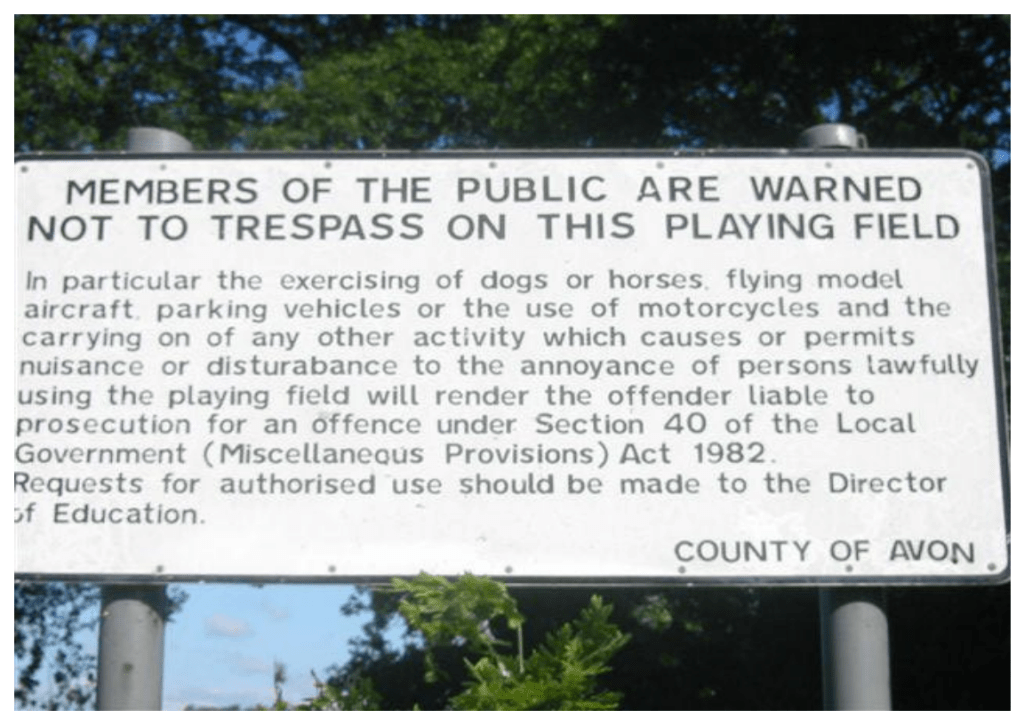
We talked previously about all the ways in which the signs that Avon County Council put up at Stoke Lodge were ambiguous and unclear (click to read more). That obviously affects whether or not the signs were effective, but there’s another question – what did Avon intend them to mean? What did it think it was doing when it put them up?
We’ve done a lot of research in the archives and found some really detailed information about this, including minutes of the Avon Education Committee from September 1982 stating that ‘the Authority, in recognition of increased public demands for facilities, has for some time tacitly accepted that its playing fields in particular can be utilised by the local community’. That’s a perfect example of acquiescence in public ‘as of right’ use.
There’s evidence that signs similar to the ones at Stoke Lodge were put up by Avon County Council at other playing fields around the county, partly to provide a warning about powers under new legislation introduced in 1982 to control nuisance activities on playing fields, and partly to encourage greater use of underused Council facilities via pitch bookings etc.
We can also see from committee minutes that after the Council put up these signs at Kensington Meadows Playing Fields in Bath in 1983/4, the activities listed on the sign had continued anyway. The committee was told that ‘the general view of local residents… appeared to be that Kensington Meadows was a public open space to which access should be freely available at all times and for all purposes, including local festivals, model plane flying, motor cycling and the exercise of dogs’. Note the similarities between the wording in these minutes and the wording on the signs!
The committee considered whether to do anything more about the situation, but resolved to take no action. There’s no reason to think that the Council’s attitude would be any different at Stoke Lodge – you have to assume it would act in a consistent way across all the playing fields it was responsible for. The signs may have been an attempt to discourage nuisance activities, but if the activities continued anyway, no action was taken. No-one was ever prosecuted or even asked to leave.
Avon’s attitude of tacit acceptance was the same after the signs as before the signs – that’s why we have so much evidence over the years of both Avon County Council and Bristol City Council acquiescing in informal use (read more here). Here, for example, is an extract from a letter to a local resident by Avon’s Director of Education dated 4 January 1990, about access at the Cheyne Road entrance to the playing field:

This gate was never actually installed, because right around this time education law changed (read more here) and Avon County Council formally resolved that it had no policy at all on the informal use of playing fields. But it’s clear that (as the Public Rights of Way and Greens Committee said in December 2016) the Council was sending, at best, mixed messages with its signs, because it didn’t actually object to informal use at all. And mixed messages aren’t enough to end ‘as of right’ use.
 We need to talk about Stoke Lodge