
In all the excitement of the decision to grant Stoke Lodge Town or Village Green status, it’s easy to forget that there is another big application waiting in the wings for its moment to be heard. Before our TVG applications (and actually before We Love Stoke Lodge really got going) there was an application in place to register four public rights of way across Stoke Lodge Playing Field, and that application has yet to come to the Public Rights of Way and Greens Committee (the same Committee as for the TVG) for decision.
The test for establishing a public right of way through long use is similar to the TVG test in some ways – you have to show that the public have used the path for a period of 20 years without force, secrecy or permission. It may seem odd, but use of a claimed public right of way doesn’t count as ‘informal recreation’ for TVG purposes (because you are using the path for a purpose, to get somewhere) and informal recreation doesn’t count for public right of way purposes. But in other ways the public right of way test is easier to establish than the test for TVG status.
Here’s the application map for the claimed paths at Stoke Lodge:
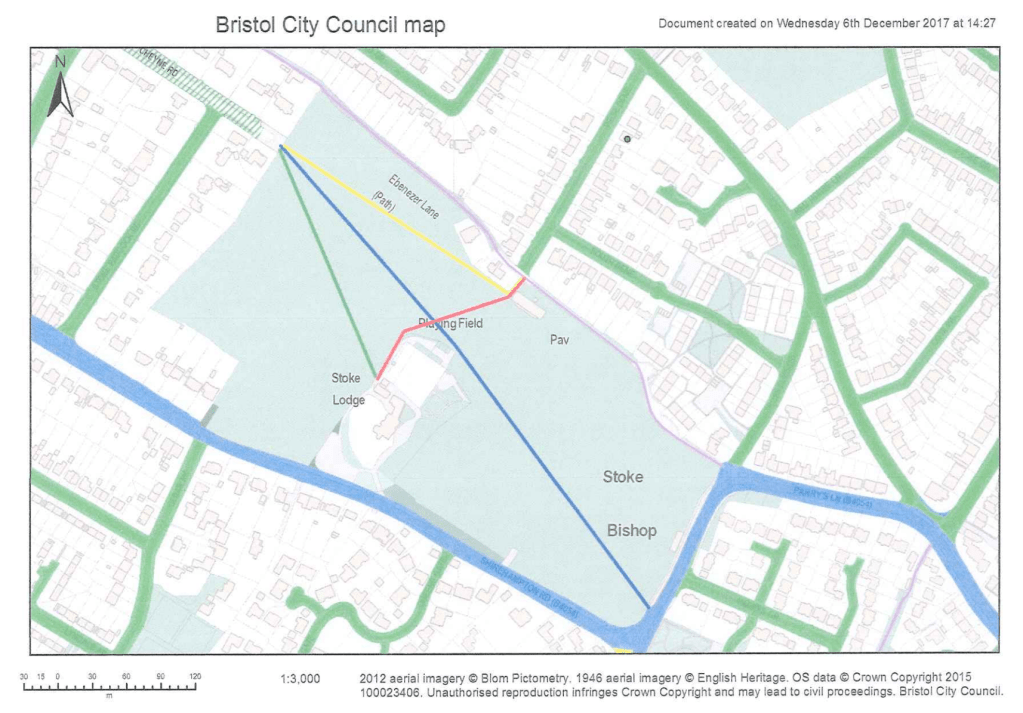
You can see that the longest path runs from the Cheyne Road entrance right up to the gap near the mini-roundabout at the top of the field. TVG aficionados will remember that there has never been any sign at either end of this path. The others run in a rough triangle between the Cheyne Road entrance, West Dene and the Adult Learning Centre.
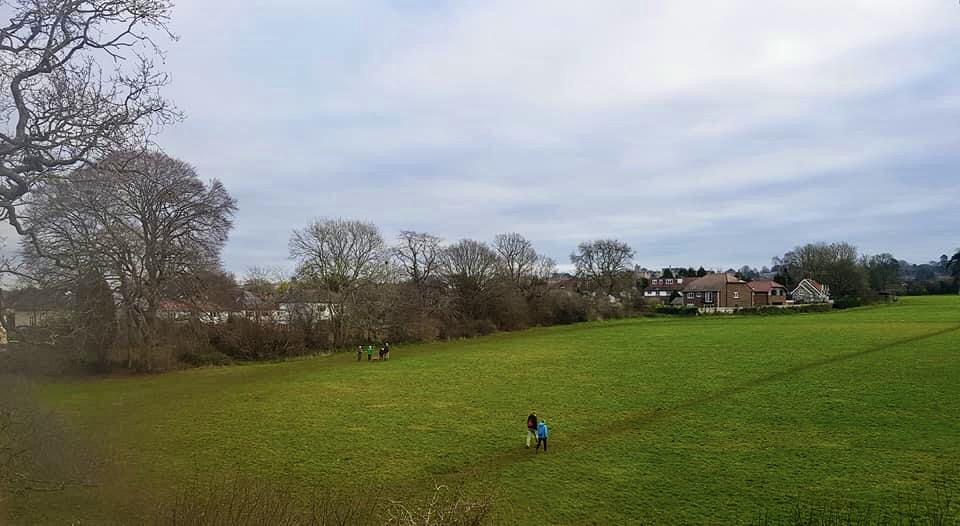
One of the discussion points at the PROWG Committee meeting on 28 June was that the wording on the old Avon signs at the West Dene entrance and at the Adult Learning Centre was ambiguous – it warned against trespass but also seemed to envisage that people would be on the land. One thing the signs didn’t do at all was to suggest that the simple act of walking across the field was off limits, and we know from Avon County Council’s own minutes and subsequent evidence that it didn’t intend to restrict either this type of use or wider informal recreation.
Why are these applications still necessary, once the TVG is in place? Because they protect a different type of use, and will protect rights of use for generations. Registering footpaths is increasingly important, in view of possible future restrictions on the ability to do this. Footpaths and greenways are a really valuable part of any neighbourhood, preserving the paths local people have walked over past generations and will continue to walk for many more. Once proved, they are marked on a ‘Definitive Map’ and protected by law.
Public footpaths often arise over time for a particular reason, and are hard to displace for that reason – for instance, in 2017 Harrow School lost a battle to divert two public footpaths running through its playing fields, even though it had built tennis courts and an astroturf pitch over one of them, as well as laying out other marked grass pitches over the second. The report of the planning inspector records that ‘the School operates in an environment of its facilities being used by members of the public and that there are many points of public access to the playing fields’ (sound at all familiar?). The planning inspector suggested that bins, not bans, would assist with any dog mess issues, and found that, despite the construction of the tennis courts and pitches over the public footpaths, the routes of those rights of way should not be diverted or obstructed. She noted that ‘any conflict is limited, both due to the fact that it is often the case that the pitches are not in use and, on the occasions when they are, all the evidence before me is that users divert around the pitch’.
So, when do we expect the Stoke Lodge public right of way application to be heard? They are currently scheduled for September 2023, though in the nature of things the investigation might take longer than anticipated.
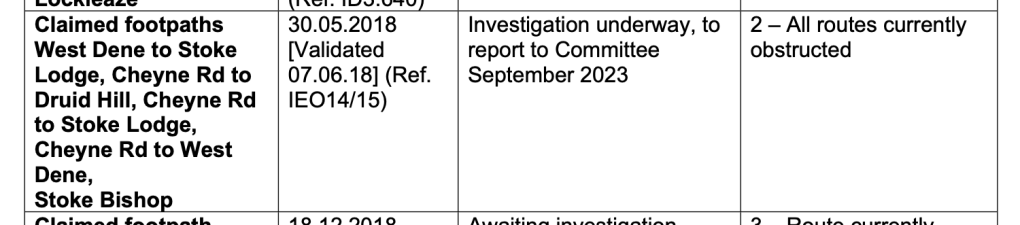
These paths have been much missed since they were obstructed – and the very limited opening of the Cheyne Road gate is a reminder of how badly access is needed at that end of the field. Of course, when the fence comes down the access issue will be resolved, but these applications are still necessary to put these historic footpaths (literally) on the map.
 We need to talk about Stoke Lodge