
Have you heard of Shopping Cart Theory? Basically, it suggests that a person’s moral character can be judged by whether they return their shopping trolley to the designated area in a supermarket car park. Returning it is objectively right, the appropriate thing to do, and pretty easy. On the other hand, abandoning it is not illegal and no one will punish you for leaving it in an empty space that is marginally more convenient for you.
“The shopping trolley is a great litmus test on whether a person is a good or bad member of society.”
The Shopping Cart Theory poses the question: will you do what is right just because it is the right thing to do? Or will you only do it when forced to under threat of punishment?
Over here at Stoke Lodge Towers we’ve been pondering this. Because you see, obstructing a public right of way is a criminal offence (section 137 of the Highways Act). So it’s not just a shopping trolley issue – UK law expressly says that you must not block or obstruct a public right of way. The offence is punishable by imprisonment for a term not exceeding 51 weeks or a fine, or both. That is a pretty strong incentive to comply – but even if you don’t think anyone will come after you for it, the law is still the law. Theft and speeding are still offences even if no one punishes you for it – or even if no one knows you did it.
This is the kind of stuff that gets taught in school – mainly in SMSC (Spiritual, Moral, Social and Cultural education), which cuts across a number of curriculum areas. Cotham School’s SMSC policy, for example, says:
“Provision for the moral development of pupils includes developing their ability to recognise the difference between right and wrong and to readily apply this understanding in their own lives, and to recognise legal boundaries and, in doing so, respect the civil and criminal law of England.”
That’s great. But when it comes to Stoke Lodge, have we seen this put into practice by Cotham School’s leadership? Past actions include the illegal use of covert surveillance; current conduct includes the installation of three unlawful mobile CCTV compounds (BCC has confirmed that these require planning permission which has never been sought). So does Cotham School recognise legal boundaries and model the respect it talks about for the civil and criminal law of England?
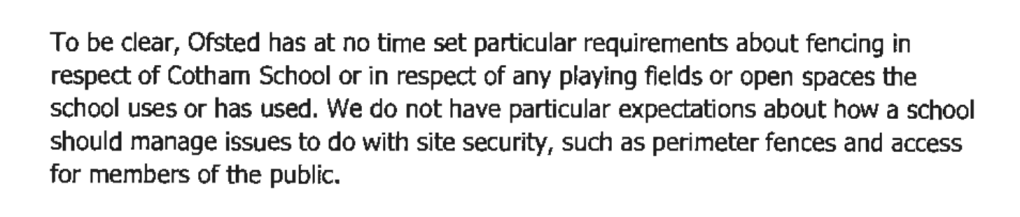
What about the public rights of way – will Cotham respect those, even though they have been told that for the moment, BCC won’t take action against them to remove the fence panels and gates that obstruct them? Because the law is still the law. Will they do the right thing just because it’s the right thing? Or will they claim that they are a special case and allowed to do the wrong thing? BCC’s reluctance to take enforcement action doesn’t change the moral obligation to act properly.
Governors at Cotham School should also be aware that this offence isn’t just committed by ‘the school’. Section 314 of the Highways Act says:
“Where an offence… is committed by a body corporate and it is proved to have been committed with the consent or connivance of, or to be attributable to any neglect on the part of, any director, manager, secretary or other similar officer of the body corporate…, he as well as the body corporate is guilty of that offence and liable to be proceeded against and punished accordingly.”
So it’s an individual challenge for each of Cotham’s governors to consider. Are you consenting to a criminal offence? Are you neglecting to prevent it? Are you comfortable with that? Or do you want to put on record now that you are not?
Because this isn’t victimless. Choosing to obstruct the rights of way at Stoke Lodge means that many people – particularly those with mobility issues or other impairments – no longer have their safe routes to walk. They are more isolated, less independent. The fence and gates mean that liberty is restricted for all of us, even though Cotham’s actual use of the field is minimal in terms of both area and time. The school could make different choices and still provide PE just as it has been doing at Golden Hill, rather than ignoring the civic rights of others.
Where do you stand on Shopping Cart Theory?


















 We need to talk about Stoke Lodge