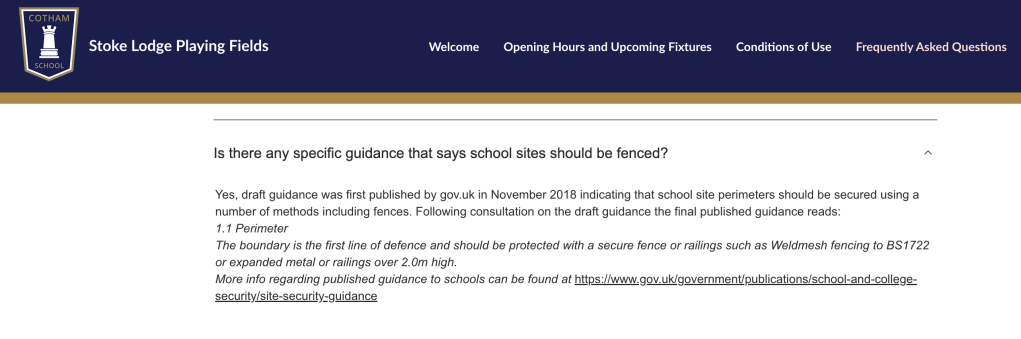
Cotham School has, for several years, tried to justify its position by saying that Ofsted requires security fencing to be installed around school sites and playing fields. We proved that this wasn’t true – Ofsted has confirmed repeatedly, to us and in its guidance to schools and inspectors, that this is not the case.
More recently, we noticed Cotham making a new claim, that the Department for Education required perimeter fencing. Here is the school’s claim:
Sounds convincing, right? The school obviously hoped so. Anticipating that it would ask its parent population to object to the TVG on that basis, we thought we would check. And it turns out that this claim is not true for several reasons. Here’s what the Department for Education said about it:
Cotham School has for several years obtained insurance via Zurich, which would mean that it is not in the DfE’s Risk Protection Arrangement, so this guidance wouldn’t apply to it at all. Even if it did, the guidance doesn’t require that all playing fields – or even all school sites – should be fenced. And even if Cotham sincerely believed that it had to comply with this guidance, the final problem is this – the guidance refers to fencing over 2m high. But the Stoke Lodge fencing is less than that because the school’s top priority was avoiding a planning application – it was never a safeguarding issue.
But mainly – Cotham is up to its old tricks. It is asking for support based on a completely false claim. There is no requirement – in law, or from Ofsted or from the Department for Education – that playing fields have to be fenced. And in the real world, that should be good news – it means that when Stoke Lodge is registered as a TVG and the fence comes down, Cotham can carry on using the field as normal. Glad we got that sorted out.
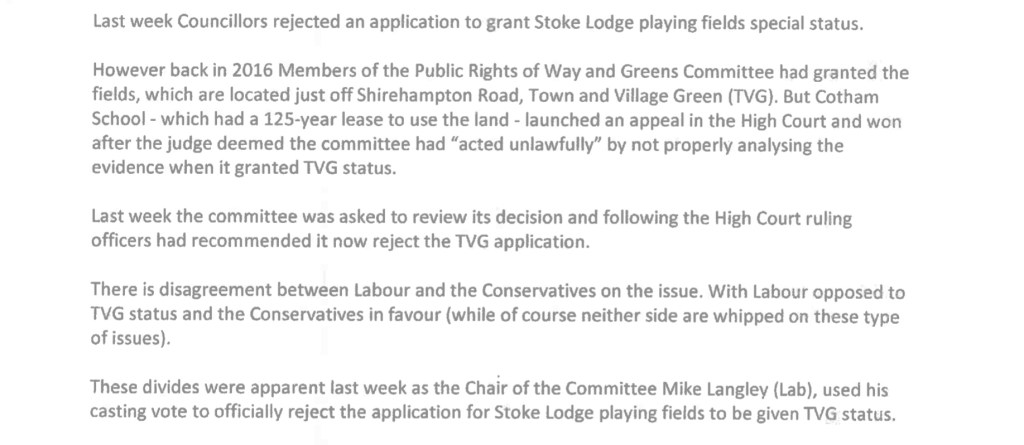
Why is the Public Rights of Way and Greens Committee about to consider whether to register Stoke Lodge as a Town or Village Green for a third time? Isn’t that unusual?
Well, yes it is unusual – but nothing about this process has ever been normal. The first TVG application involved a public inquiry; the subsequent Inspector’s report was considered at a PROWG meeting on 12 December 2016. The Inspector had recommended that the land should not be registered, on the basis that the Avon signs made use not ‘as of right’ during the first five years of the TVG1 period, up to 1996. But the Inspector’s report is only a recommendation – the decision has to be taken by the Committee itself.
At that meeting, the PROWG committee discussed the relevance of the Avon signs and the Winterburn case at length. They rejected the Inspector’s recommendation, giving as a reason: ‘Three members of the Committee considered that the facts in Winterburn v Bennett [2016] EWCA Civ 482 were not the same as the facts of this case… The small number of signs on such a large site was not sufficient to make the use of the land contentious.’
Cotham School challenged that decision by way of judicial review, and the Council defended the Committee’s decision to register the land. BCC argued that there were not enough signs, and that:
Given that Cotham School took the lease after the [2011] TVG application had been made and that shared use was then being carried on, the school was aware of the position and potential implications [of registration as a town or village green].
Registration would reflect what has been the position on the land for at least the twenty-year period prior to the application.
It appears that the land has been used for a very long period for recreational purposes by the local community and the importance of the protection of recreational uses that arise from [TVG] registration should not be overlooked.
The High Court said that it was ‘not controversial’ to say that Stoke Lodge is very different to the car park in Winterburn, but that the Committee’s decision-making process and reasons had not been adequately recorded (the minutes did not explain why, having accepted his report, the Committee had departed from the Inspector’s findings).
That meant that the PROWG Committee had to reconsider the application in June 2018. At this meeting there was very little discussion about the issue of signs and no discussion of whether ongoing use was contentious. After discussing the financial and party political implications of the process to date, a vote was taken and the Committee split 50/50 on political lines. On a casting vote, the decision was made to accept the Inspector’s recommendation and reject the application.
An email from Ben Mosley (Head of the Executive Office) to Mike Jackson on 4 July 2018 provided the following briefing:
It’s important to say that this is not, and should not be, a party political matter. Members of the Committee are being asked to consider a legal test on the basis of the evidence before them. Matters about the protection of, and public access to, green space, are important to Councillors on all sides of the Chamber and from wards right across the city. That’s why Full Council passed a Golden Motion in September 2021 to protect Bristol’s green spaces. That Golden Motion included a statement that ‘The need to conserve the existing Green Belt, as well as retaining vital green spaces, remains a major priority for most people in our city.’
Full Council resolved to ‘work with local communities across Bristol to similarly make every effort to designate much loved green space in other parts of the city and noting that such protection for green space was proposed as part of the recent Bristol Local Plan Review.’
We all want to preserve our green space and our mature trees. We don’t want to see it buried under astroturf or tarmac, or dazzled under the glare of floodlights. We know that Cotham’s ambitions to develop and commercialise Stoke Lodge lie behind its objection to TVG status (click here to read more). PE lessons at Stoke Lodge are not under threat from a TVG, but this important open space is certainly under threat of future development by Cotham School.
We hope all Councillors on the PROWG Committee will, on the basis that the legal test for registration is fully met on the evidence, support us and decide to register Stoke Lodge as a TVG on 28 June – once and for all!
We’ve looked at what was going on behind the scenes in summer 2018 between Cotham School, Mike Jackson and Gary Collins – but what was happening in public?
First, when Cotham published its proposed fence plan in May 2018, Gary Collins told the school in no uncertain terms that it couldn’t do that without a planning application. And on 13 July 2018 BCC sent the school a formal letter confirming that. It also said that any application by the school must recognise community use of the land and mitigate any restriction of public access. So from the community’s point of view, there would be a planning application before any fence could go up – we would be consulted, and a range of factors including accessibility and discriminatory impacts; wildlife and trees; the heritage status of the land and the maintenance of the perimeter walkways would all be considered.
On 20 July 2018 Darren Jones MP hosted a mediation meeting between the community and the school, at which compromise solutions and alternatives to fencing were discussed and the school participants committed to considering these over the summer.
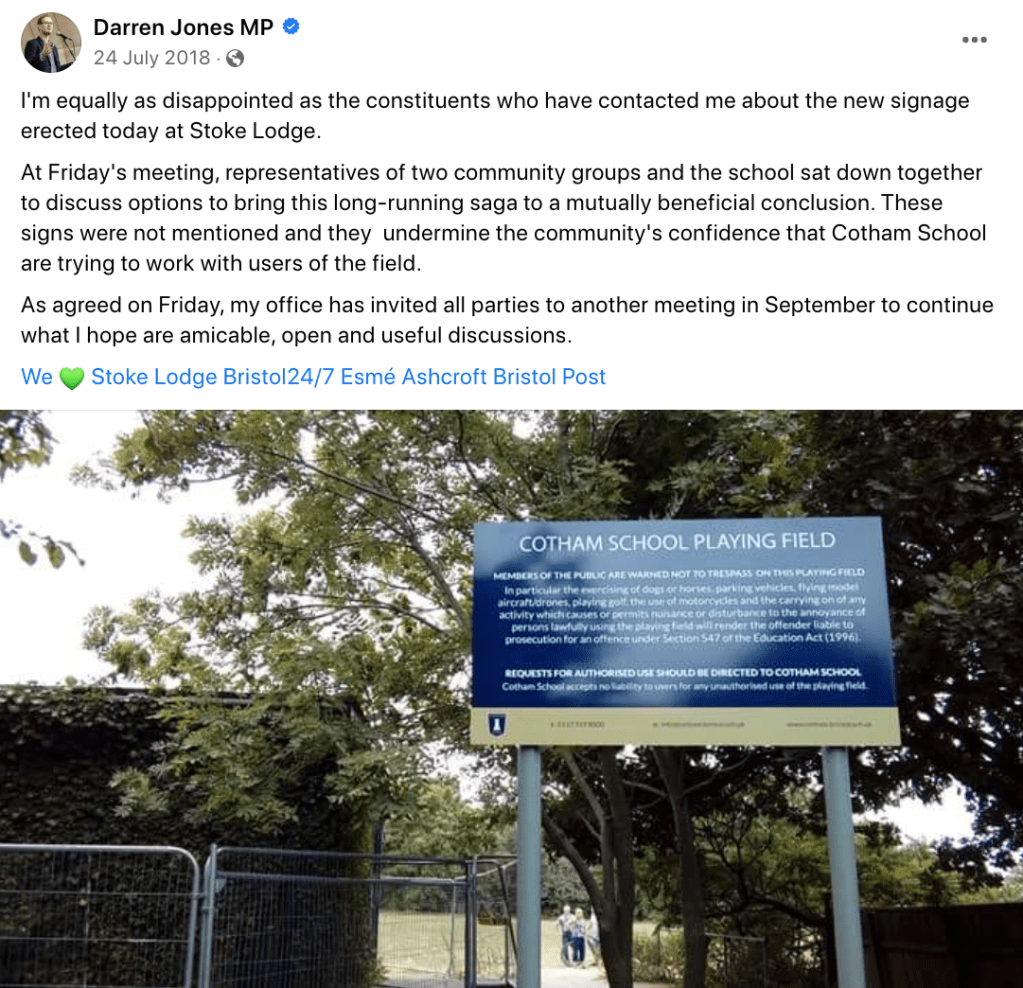
But then on 24 July 2018, with no warning (including to the Council), Cotham School removed the Council’s existing signs from the land and replaced them with its own, renaming Stoke Lodge as ‘Cotham School Playing Field’ and claiming it as their private property with no unauthorised access.
Obviously, things kicked off at that point. Here is Darren Jones’ response:
We wrote to all Councillors that same day, asking for urgent intervention. We said:
‘We are very disappointed that, having attended a meeting only a few days ago to discuss ways of resolving the situation, the school has taken this action, which it had clearly decided on before that meeting. This indicates a lack of good faith in its conduct towards the community and to Darren Jones who facilitated the meeting, as well as a disregard for the Council’s wishes…
As a community we have considered the possibility of making a second TVG application… the school’s challenge to the Council’s earlier decision to award TVG status resulted in significant costs in time and money for both the Council and the local community and out of respect for our Council’s resources, our thinking has been that we would not make a second TVG application at this time. However, if the school does not wish to work in partnership with the community we will have no option but to review our position.’
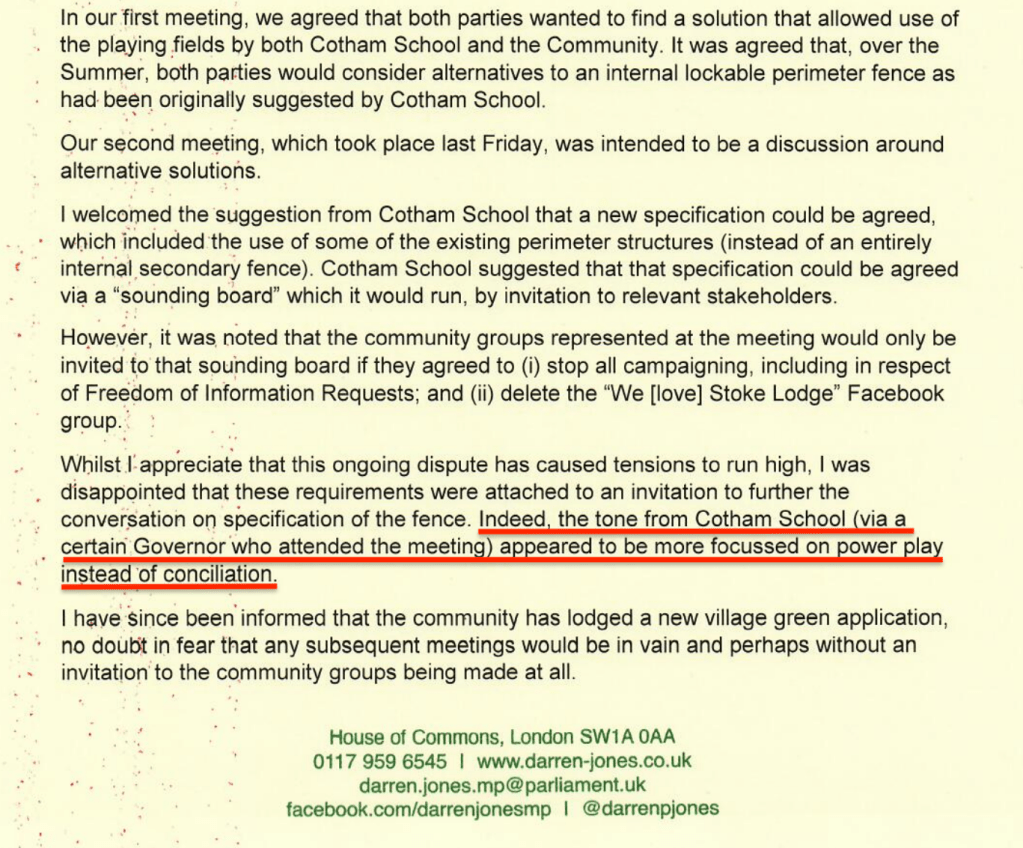
It shouldn’t therefore have come as a shock that when Cotham showed up to the next mediation meeting on 14 September, saying that they had not even bothered to look at our alternative proposals over the summer, we decided to act. The school’s conduct in that meeting was particularly belligerent – no doubt because they now felt they had Mike Jackson’s private backing (click here). We were told that unless we closed down our Facebook page, stopped making information requests and stopped campaigning, the school would put a bigger fence around even more of the playing field and never unlock the gates.
Here’s how Darren Jones described that meeting:
That’s correct – if Cotham’s lead governor had been less focussed on backroom negotiations and power play, and had engaged with mediation in good faith, then perhaps the TVG application might not have been made following that meeting. And if Cotham had not tried to evade normal planning processes, and had just made an application following the same rules that apply to everyone else, the TVG application could not have been made, precisely because of the planning process. Cotham’s own conduct both provoked and enabled these applications.
As things stood at the end of September 2018, Cotham School had been told that the Council had decided to remove curtilage status from Stoke Lodge, but that it would have to comply with BCC’s requirements on the height, design and layout of the fence to get landlord approval – a minimal level of control over Cotham’s plans, but all that was applicable after the curtilage u-turn. We also know that the Council’s view was that less fencing (not encircling the whole field) and fencing of a more appropriate design for a heritage parkland estate would be required.
But then it seems that someone noticed that clause 3.5.2 of the lease states that the school is: “Not to erect any buildings or other structures on the Property nor make any structural or external alterations additions or variations to any structures for the time being on the Property”. And, when this was pointed out, the Council decided that it didn’t want to be involved in giving (or withholding) consent to the fence. And so its legal team was asked to give another view – this time on whether it could be said that the fence was not actually a structure after all.
We’ve been told that the legal team came back with the following comments:
[The barrister] has already decided that planning permission is not needed, and it is therefore not unreasonable to assume, for the purposes of the lease, that the fence is not a structure. But this means, of course, that one faulty decision has been used as the basis for another. And in any case, you can build a conservatory or a garage without planning permission if you meet the right conditions – that doesn’t mean those aren’t structures! This is a completely false assumption based on a bad foundation. It’s nonsense.
The Landlord is not concerned with the day-to-day management of the premises. No, but the Council as landlord should be concerned with whether its tenant is keeping to the terms of its lease. It appears that whoever looked at this clause didn’t bother to read the lease as a whole, including the community use provision. And in any case, installing a 1.6km long, 2m high fence and concreting it into the ground is absolutely not ‘day to day management’ of the premises. It’s something very different.
It could be argued there is a statutory duty to fence the land for the protection and safeguarding of the children using it. In which case, the Council’s consent is immaterial. But it was well known by this time that there is no statutory duty to fence the land – Ofsted had already confirmed it does not require fences around detached playing fields. That had received wide coverage in the local press. There is no excuse for the Council using this line if it had been acting as an honest broker and seeking the truth. Instead, it seems to have been looking for an answer that was convenient for avoiding responsibility for the consequences of its actions.
BCC’s Monitoring Officer reviewed this but apparently didn’t agree with all of it. His view was that ‘In the case of long leases such as this one the Lessee is responsible for the maintenance of the land and for ensuring that it is fit for purpose’ – but again, Ofsted had made very clear that playing fields can be fit for purpose without a fence, and installing a huge fence is very obviously not ‘maintenance’. And just because a lease is long, that doesn’t mean the terms expressly written into it – like ongoing community use – can be ignored. As a lawyer, the Monitoring Officer knows this – so why give such a lame response? It might suggest that he just wanted to give a reason (even an invalid one) to support the decision that had already been made.
And of course it’s on this basis that Mayor Marvin Rees went on to say to a highly sceptical audience at Full Council that ‘the fence is not a structure’ (click here) and that ‘I really don’t have power over this. It’s been through the Monitoring Officer’ (click here).
This is how it happens. It’s how the game is played. This is how we lose access to our green spaces all around Bristol.
We already know that the school was told on 21 September 2018 that the Council had done a U-turn and removed curtilage status from the parkland around Stoke Lodge.
But you can see two things here – first, Gary Collins was going to get an opinion from an external barrister to back up its new position ready for the ‘inevitable legal challenge’ from residents. That barrister’s opinion was based, of course, on the same bad information as the view from the internal team. And our Ward councillors have never been allowed to see a copy of the barrister’s opinion, even under conditions of confidentiality (link here) – an unusual (possibly unprecedented) situation.
We also don’t know what question was put to the barrister, but we know that when the answer came back, this is how Gary Collins communicated it to the school:
‘No surprises there’. It’s an odd way to communicate what the barrister’s conclusion was, don’t you think? Unless both parties already knew it was set up to be a foregone conclusion…
Secondly, it was still the Council’s view that the school would need landlord consent under the terms of the lease. This wasn’t likely to be a big obstacle, as you can see from Gary Collins’ email to Mike Jackson above, and he made it even clearer to Cotham School on the 27th of September:
As an aside, here’s Sandra Fryer’s response to that email:
Cosy, isn’t it? Wouldn’t want to give the community a ‘chink to pop at’. Or, you know, any voice in a consultation process. It is absolutely clear that Cotham School felt it now had the Council in its pocket – here are some other examples:
This is the start of a letter from Jo Butler, Head of Cotham School, to Mike Jackson, referring to a meeting with him on 20 August (only 3 days after the school’s free planning consultant sent its error-filled letter – the ink was barely dry). Notice that she left that meeting – way before any legal advice was received – reassured that the Council was on the school’s side:
And, in similar vein, here’s Sandra Fryer, the Chair of Governors, the day after being given BCC’s u-turn decision on curtilage, content that the Council is now ‘fully engaged’ with Cotham ‘as you were when the TVG was first submitted’:
Even the Legal Services team seems to have been cosier with Cotham then you might imagine, passing on to Cotham a copy of a letter sent to WLSL and asking the school to keep that quiet (the rest of us spend years stuck in FOI limbo trying to get access to documents but if you’re in the in-crowd you don’t even have to ask):
In amongst all this cosiness, we know that ultimately the Council’s view was that the ‘fence is not a structure’ and that landlord consent was not required for the fence. So what happened? Tune in next time…
We’ve explained previously that BCC officers confirmed to Cotham School in July 2018 that the playing fields were the curtilage of a listed building, so that a planning application would be required for a fence. Cotham then sought a meeting with planning officers, taking along an external planning consultant to plead their case (who was apparently doing this for no charge, although it’s not clear why he would have agreed to act for free). Gary Collins, the Head of Development Management, told the school that he would be prepared to reconsider the Council’s position ‘if a case could be made’.
And so the planning consultant wrote a letter to BCC on behalf of Cotham School. The letter claims that it would be ‘pivotal and devastating’ for Cotham to have to go through a proper planning consultation process in order to put up a perimeter fence. Why would it be ‘pivotal and devastating’ to have to make a planning application? Presumably because the BCC planning team had firmly rejected the same proposal when the school made it previously.
That’s right, the school had made a planning aapplication for exactly the same fence in late 2016, and officers slammed it for its poor design, for creating a ‘more threatening environment’ and for failing to address the impact on Stoke Lodge house, a heritage asset. They also said that restricting access to a 5m strip in parts was ‘a provocation’ (the reality is that the perimeter walkways left outside the fence are much narrower than that in places – so even more provocative).
In his letter, the planning consultant claimed that prior to July 2018 BCC officers had never suggested that the parkland had special curtilage status. Gary Collins could easily have checked and seen that this was untrue – years of planning and tree works applications on Bristol Planning Online show that listed building constraints apply to the whole of the estate. So that was a false claim. Here is the record for the school’s previous fence application showing permitted development rights were removed (so the school clearly knew that the ‘fact’ it was claiming wasn’t true):
The planning consultant also printed off a number of old maps that he said demonstrated that the land had been in other uses and therefore couldn’t be considered to be the parkland of a historic estate – for example, he claimed that the land had been used as allotments:
But if you know Stoke Lodge, you can see that the allotments are somewhere else. Was that a deliberate lie or just incompetence? Perhaps he didn’t know where the boundaries of Stoke Lodge are and that’s why he didn’t mark them on the map, but the allotments marked are certainly outside those boundaries. And again, the planning team should have known that – or could easily have checked. The letter is riddled with other errors, including the misquoting of guidance from Historic England and a repeated claim that officers have never previously considered the land to have curtilage status.
Even the most basic effort by Gary Collins or his team to verify the information in this letter would have shown that none of its claims held water. But apparently no one ever bothered to verify it. The letter was treated as if its claims were true and was passed to the BCC legal team to give a view on whether permitted development rights should apply. And the legal team came back and said that based on that information – that unverified, largely false, information – ‘on the balance of probabilities’ BCC could take the view that the curtilage was a smaller area, directly surrounding the house.
We haven’t seen that legal advice, of course – it’s privileged. Nor have we seen the question that was put to the legal team. Was it a neutral question based on full facts, or was it ‘Does this give us enough to say that permitted development rights apply?’ – those two questions are very different in both intent and outcome. The Council has a legal duty to take reasonable steps to acquaint itself with the relevant information to enable it properly to perform a relevant function. So it should have taken reasonable steps to fact-check the letter and ensure it was correct, and it seems that this was never done.
Perhaps it has never occurred to Mr Collins that a developer seeking a specific planning-related decision would try to skew things in their own favour by making false claims? Perhaps we’re all just too cynical. Or perhaps this is how it’s done, by deliberately turning a blind eye as long as people play the game and the Council can claim it went through the right processes.
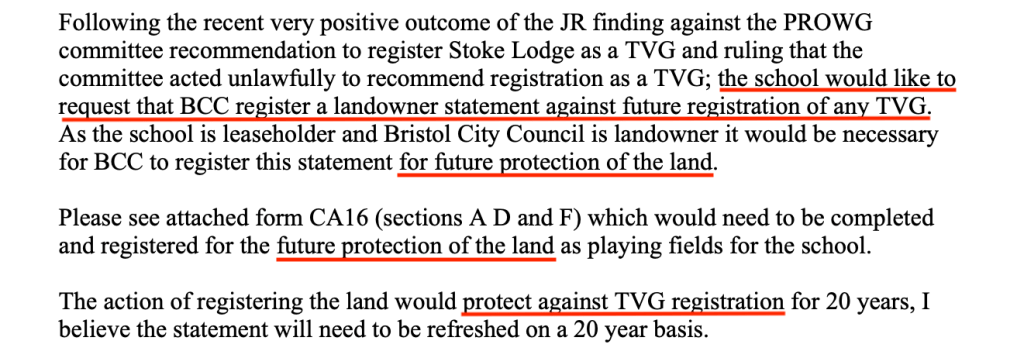
We’ve talked before about the long and vexatious struggle to get Bristol City Council to disclose correspondence about the possibility of making a landowner statement in relation to Stoke Lodge. If you want details of the FOI saga, click here.
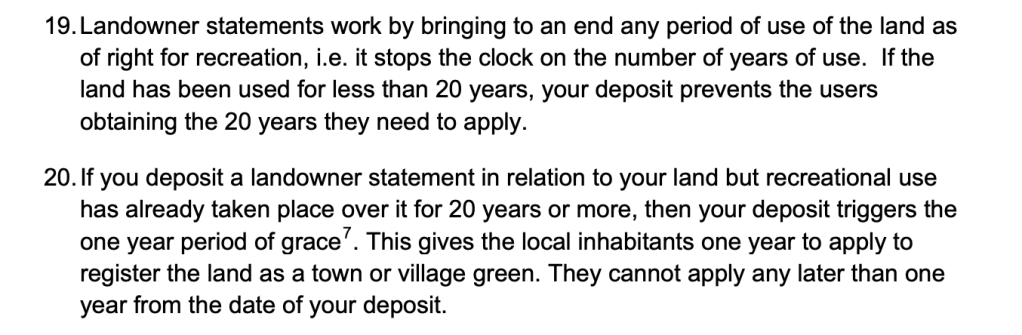
A landowner statement is a mechanism under the Commons Act 2006 that allows landowners to protect land from registration as a town or village green and from claims for additional rights of way. The sole purpose of this is to ‘bring to an end any period of recreational use ‘as of right’ over land’:
That’s from the official DEFRA guidance, which also explains:
So, if a landowner has an opportunity to make a landowner statement before 20 years of ‘as of right’ use have accrued, and it wants to stop the clock on that use, it has a really easy way to do that. But if 20 years’ use are already in the bag, then depositing the statement might trigger a TVG application.
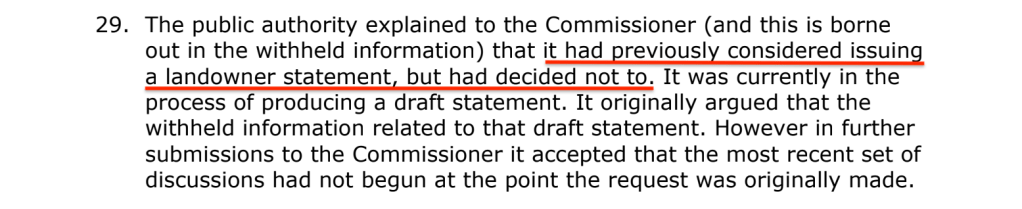
We know that Cotham School had been asking BCC to make a landowner statement for Stoke Lodge, and we know that no statement was made. We asked for copies of the correspondence around those discussions. And BCC said we were vexatious, but a month ago it changed its mind and said that actually the correspondence couldn’t be disclosed because it was legally privileged and/or internal communications and/or a live and ongoing matter.
The Information Commissioner has acted very quickly to look into this, in view of the relevance of the information to an active legal process. The ICO has ordered some of the material to be disclosed (but not the material that was legally privileged or genuinely covered by the internal communications exemption). The ICO had no truck with BCC’s claim that it was a live matter, because, as the case officer pointed out, BCC hadn’t restarted any such discussions until after the FOI request had been made (it seems as though someone thought that might be a cunning plan to avoid disclosure!).
We don’t yet have the documents that are due to be disclosed, but possibly the most significant statement is the one made by BCC to the Information Commissioner, underlined above. We now know that BCC got detailed legal advice about this issue, and on the basis of that advice it decided not to make a landowner statement ending ‘as of right’ use.
Remember that this is happening in 2018. Clearly, either BCC thought that ‘as of right’ use was still ongoing and it didn’t want to take action to stop that, or it thought 20 years of ‘as of right’ use had already built up, and it didn’t want to provoke another TVG application (which happened anyway because of the school’s stubborn refusal to talk about compromise solutions).
Either way, that absolutely confirms our case for registration. Neither Cotham School (because it was asking for a statement), nor the Council (because it decided not to make one), nor any of their legal advisers, thought in summer 2018 that ‘as of right’ use had ended. And that also means they didn’t think the Avon signs were effective either (otherwise ‘as of right’ use wouldn’t exist). They’ve spent an awful lot of time and money arguing the opposite, which is a real shame because it seems they actually agreed with us all along!
One of the issues that the parties have been arguing about in this TVG process is whether and when ‘as of right’ use of the field ended. Obviously neither the School nor the Council would be arguing about this at all if they thought ‘as of right’ use wasn’t going on – what they’re claiming is that use became contentious at some point from 2016 onwards, because that would mean a full 20 year period couldn’t be established.
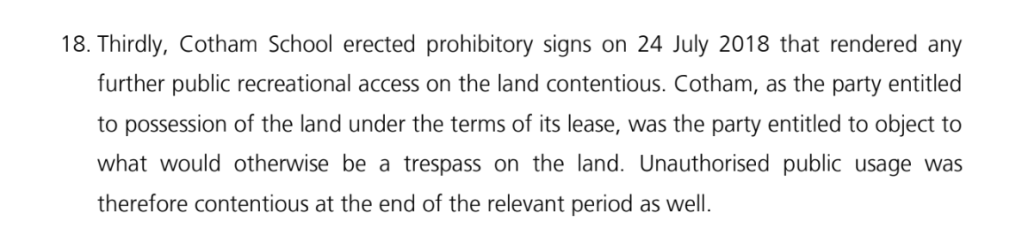
You may remember that in July 2018 Cotham School abruptly removed the old Avon County Council signs from the site (without asking BCC first) and put up its own signs. In its objection to TVG2, Cotham told us that the new signs were intended to ‘restrict access to the site by members of the public’ and to ‘render use contentious’ – so the whole point of putting the signs up was to try to change the situation from ‘as of right’ to ‘not as of right’. That’s what they thought they were doing on 24 July 2018. The Council agreed with that interpretation, in its objection to TVG2.
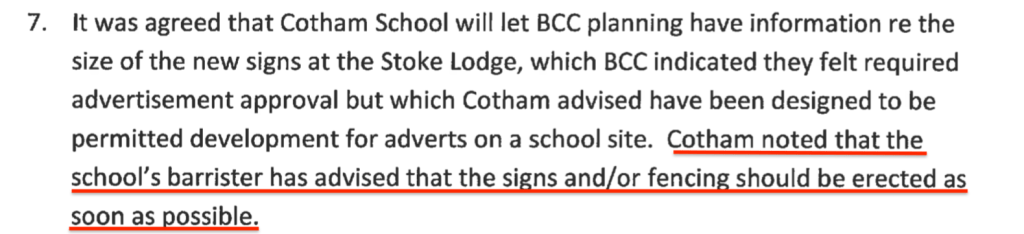
The signs were very controversial at the time, and the Council’s planning enforcement team opened an investigation into the school’s actions. The issue came up at the school’s meeting with Gary Collins on 3 August 2018:
Clearly the barrister thought ‘as of right’ use had not ended, so the school should put up signs and/or fencing to achieve that. That means Cotham School, its legal advisers and the Council all thought that ‘as of right’ use was going on right up to 24 July 2018. And the local community objected to the new signs very strongly, so they didn’t think ‘as of right’ use had ended at any point before that, either. At least we all agree on something!
Why does this matter? Because Cotham is now trying to claim that ‘as of right’ use ended earlier than this, possibly because of the public inquiry in 2016. Or possibly because of its proposal to put up a fence in May 2018 (but the Council objected to that) or possibly because of the PROWG decision in June 2018 (but that only actually decided that use was not ‘as of right’ between April 1991 and April 1996).
The fact that Cotham finds it so difficult to pin down a date when it thinks ‘as of right’ use ended is a pretty clear indication that it didn’t actually happen, and that no such message could possibly have been communicated to users of the field. It’s clear that the school was trying to end ‘as of right’ use on 24 July 2018 and that this is what its advisers were telling it to do – but of course whether the signs were valid and effective would depend on whether it had power under the lease to restrict informal use and whether it had put up enough, clearly-worded, signs. Since Cotham had essentially copied the wording of the ambiguous Avon signs and put them up in the same three places, and since its use was subject to community use anyway, the community never thought the signs were valid.
Because it thought ‘as of right’ use was still ongoing, the school was also pursuing its request for a landowner statement, which is another smoking gun for the TVG applications.
In autumn 2018 Council officers waved through two of the new signs as ‘advertisements’ but required the school to seek planning permission for the third. That application was rejected by Development Control Committee B on 19 December 2018 with Councillors saying the following:
The councillors clearly weren’t keen on what the school had done: note the comment that ‘planning consent cannot be used to restrict or prevent free public access to the land’ – but the TVG3 application relates to a period ending just before the signs were put up, so we haven’t needed to spend extra legal funds arguing this specific point.
The issue, in the end, is that since neither Cotham School nor the Council thought ‘as of right’ use had ended before the signs went up, there’s no reason to think that local residents should have thought that. After all, the school was paying an expert barrister to analyse the position for them, and he thought ‘as of right’ use was still ongoing! This argument against registering the land as a TVG just doesn’t work.
What on earth has a car park behind a fish and chip shop in Keighley got to do with Stoke Lodge? Well, we discussed in a previous post how a Court of Appeal decision about that car park caused the Inspector to change his mind in TVG1 and to recommend that Stoke Lodge shouldn’t be registered as a village green.
The issue is this: if a landowner puts up signs declaring that land is private, that can have the effect of making informal use of that land contentious or not ‘as of right’. But to have that effect, signs have to meet certain conditions – for example, they have to be clearly worded; they have to be put up in the right places (so that users see them); and there have to be enough of them. The core question is whether the landowner has made clear its ongoing objection to informal use by local inhabitants.
The Winterburn case itself involved a small car park for 7 cars, with one entrance and two visible signs that said ‘Private car park. For the use of Club patrons only’. In some ways it was an easy case – there was no issue about the wording of signs being unclear, and there was no issue about whether there were enough signs – you couldn’t get into the car park without seeing them.
The key quote from the case, on which the Inspector focused in TVG1, was: ‘In circumstances where the owner has made his position entirely clear through the erection of clearly visible signs, the unauthorised use of the land cannot be said to be “as of right”… I reject the notion that it is necessary for the owner, having made his protest clear, to take further steps…’.
The question that the Winterburn case didn’t ask or answer is – what happens if the landowner, having put up signs, then acts inconsistently with them over a period of decades? What if its employees chat amicably on a day to day basis with people walking dogs on the land, even though the signs say you can’t do that? What if the landowner gives a statement to the local press saying it intends to put in a kissing gate at one entrance, to discourage motorbikes but allow easy access on foot? What if the school using the land instructs its maintenance contractor that ‘the land is open, at present, to the public and dogs’? The list goes on – see our post ‘13 ways the Council and Cotham School showed they didn’t object to informal use‘.
The point is that the landowner is, by those actions, indicating that it doesn’t actually object to informal use. It is contradicting the signs, so it isn’t making any continuing objection clear. Winterburn tells us that if the signs are enough by themselves, then a landowner isn’t required to take further steps – but it simply doesn’t address a situation where the landowner is actively, by its conduct, contradicting its own signs. Nor does it cover a situation where the current landowner (Bristol City Council) never puts up any signs of its own, but there are signs left behind by a previous landowner (Avon County Council) – and the new owner is acting inconsistently with those.
The Inspector didn’t have to consider those issues specifically in TVG1, though he said that based on the Council’s conduct alone, without the signs, he would have said it was a ‘classic case of acquiescence’. There is much more evidence before him in these applications showing that acquiescence in great detail, as recorded in formal documents. That includes evidence that:
the signs were ambiguous (read more here) and were intended as a warning rather than a prohibition;
there weren’t enough signs – only two of them, on a site that is 200 times larger than the Winterburn car park, with dozens of formal and informal entry points plus residential back gates directly onto the field (read more here); and
the Council and the School acted inconsistently with them from at least January 1990 onwards – so how is it possible to say that any clear objection to informal use was conveyed to local residents?
The High Court commented in 2018 that it was ‘not controversial’ to suggest that the situation at Stoke Lodge is very different to the Winterburn car park. Frankly, it’s obvious – below is an aerial view of Stoke Lodge with an overlay of the car park, to scale. And in December 2016, the Public Rights of Way and Greens Committee thought that the difference was obvious too.
But it’s not just the difference in size and the lack of any signage at the vast majority of entrances that makes our case different. The Winterburn decision states that ‘the circumstances must indicate to persons using the land that the owner objects and continues to object‘ to informal use. If you stick up a sign and then spend years actively indicating to everyone that they are welcome to use the land, then your objection to that use isn’t clear – in our case, it never was!
We’ve explained previously (click here) that even after the Council had performed a u-turn at Cotham’s request and removed curtilage status from the playing fields, it was still the Council’s position that the type and height of fencing used would have to be acceptable to the Council in order for the school to obtain landlord’s consent. Officers had described the school’s previous proposal (which was identical to this one) as a ‘poor quality’ design that created a threatening environment and said that the layout (leaving only narrow strips outside the fence) was ‘provocative’.
It was only after the curtilage u-turn, sometime in October or November 2018, that the Council was persuaded to retreat further and hide behind the idea that ‘the fence is not a structure’ so that the Mayor could say, as he did at Full Council in January 2019, that he had‘no power over this‘.
The Council’s decision that the fence was not a structure was just what Cotham needed to hear, because it never had any intention of changing the design or layout of the fence to align with the Council’s preferences anyway. It had always intended to install weldmesh perimeter fencing. This typically costs around £31/metre and its quotes were around £35k/£40k for the whole perimeter: Sandra Fryer reported these details to the Finance, Premises and General Purposes Committee of the governing body back in March 2015:
The school then applied for grant funding for the fence totalling. £152,700, basing its request on a nice round £100 per metre rather than the £31 it expected to pay, and thereby obtaining a significant amount of extra funding:
Private Eye magazine has taken a close interest in this part of the story.
Back in June 2021, the focus was on how the costs of the fence had apparently escalated dramatically from the £35-40k quoted to Cotham School before it applied for grant funding, to the £152,700 it requested from the Education and Skills Funding Agency to pay for the fence:
The school, meanwhile, assured parents of its ‘robust project management and use of value for money principles’, saying that the fence would cost no more than £65k:
Ultimately, after an audit of the project at the end of 2021, the Education and Skills Funding Agency decided that Cotham’s total grant funding for the fence would be reduced by £55k, as reported here in April 2022:
But the Eye returned in August 2022 to report that the fence had been rather less successful in practice than hoped: