“Stoke Lodge is the hub of its community, criss-crossed by spokes of connections and daily trips, old footpaths that emerge like ghosts in a drought, but are in use all the year, joining up people’s lives, stitching together a shifting but palpable community.”
That’s how Kathy Welham recently described Stoke Lodge and its well-used, long-established paths connecting residents on each side of the Lodge to school, to the shops, to the Trym Valley and Blaise, and to each other (for Kathy’s full text click here).
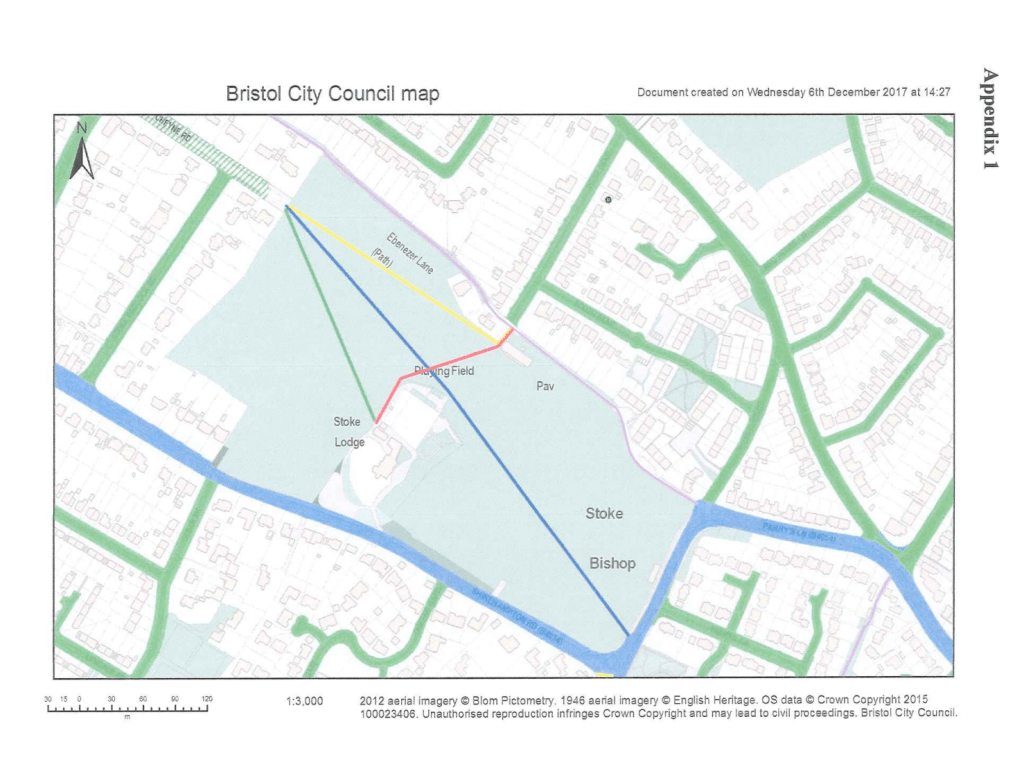
On 27 November the Public Rights of Way and Greens Committee will consider applications to register these key routes as public rights of way. Here’s the application map showing the four routes that were applied for back in May 2018:
You might be thinking “But since Stoke Lodge is already a village green, what’s the point of these applications?”. The answer is that the nature of public rights of way is different from village green rights – for one thing, they are truly public. So if these routes are registered, anyone who wants to try the Bristol Green Walk (a 7 mile (11km) route between Clifton Suspension Bridge and Penpole Lane, Shirehampton) will know that this section is on registered rights of way. Find out more about the Bristol Green Walk here.
Public rights of way are protected by law and cannot be obstructed. They are recorded on something called the ‘Definitive Map’ (although many rights of way are currently unrecorded, so the map isn’t actually as definitive as you might suppose!). There’s an interactive version of the Map here.
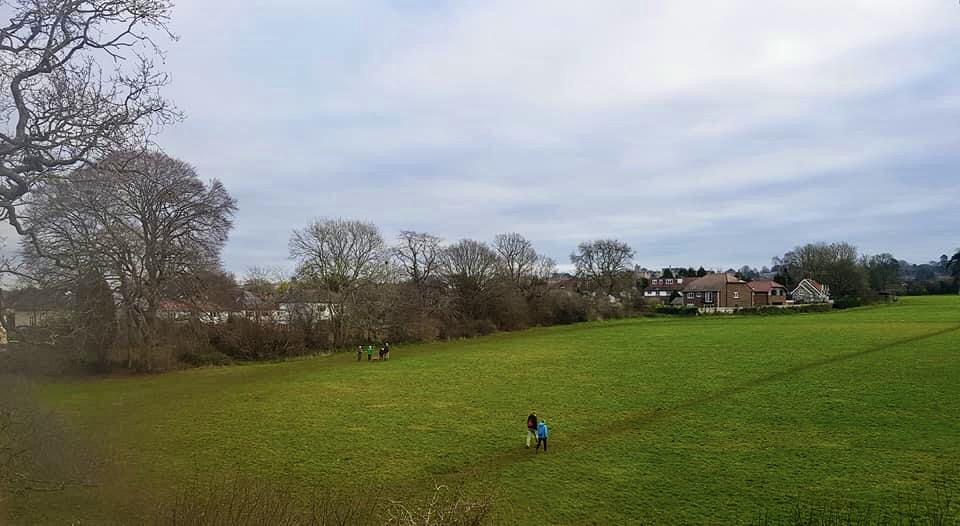
So whether it’s the route to school:
…or a walk to the shops:
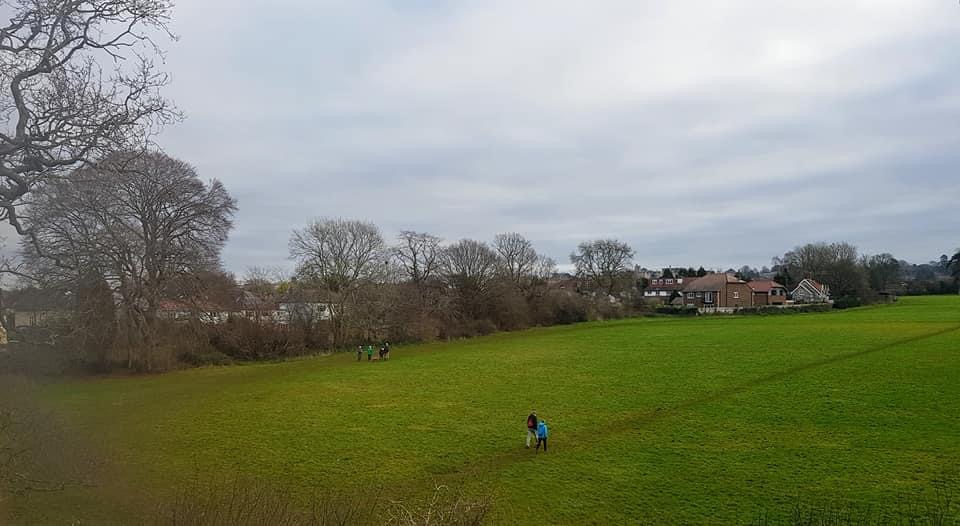
…in winter:
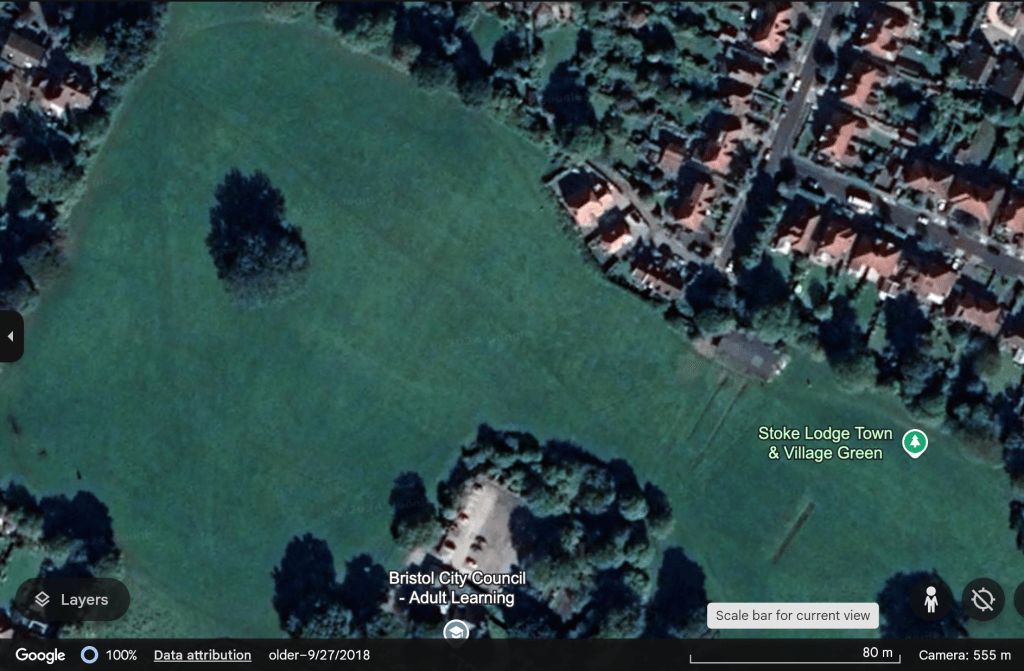
…or from above:
…routes like these connect a community – and do their bit to keep all of us out of our cars and in the open air!
There’s exactly one month to go before we know whether these four new routes will be added to the Definitive Map. Fancy a walk? We’ll keep you posted!
In all the excitement of the decision to grant Stoke Lodge Town or Village Green status, it’s easy to forget that there is another big application waiting in the wings for its moment to be heard. Before our TVG applications (and actually before We Love Stoke Lodge really got going) there was an application in place to register four public rights of way across Stoke Lodge Playing Field, and that application has yet to come to the Public Rights of Way and Greens Committee (the same Committee as for the TVG) for decision.
The test for establishing a public right of way through long use is similar to the TVG test in some ways – you have to show that the public have used the path for a period of 20 years without force, secrecy or permission. It may seem odd, but use of a claimed public right of way doesn’t count as ‘informal recreation’ for TVG purposes (because you are using the path for a purpose, to get somewhere) and informal recreation doesn’t count for public right of way purposes. But in other ways the public right of way test is easier to establish than the test for TVG status.
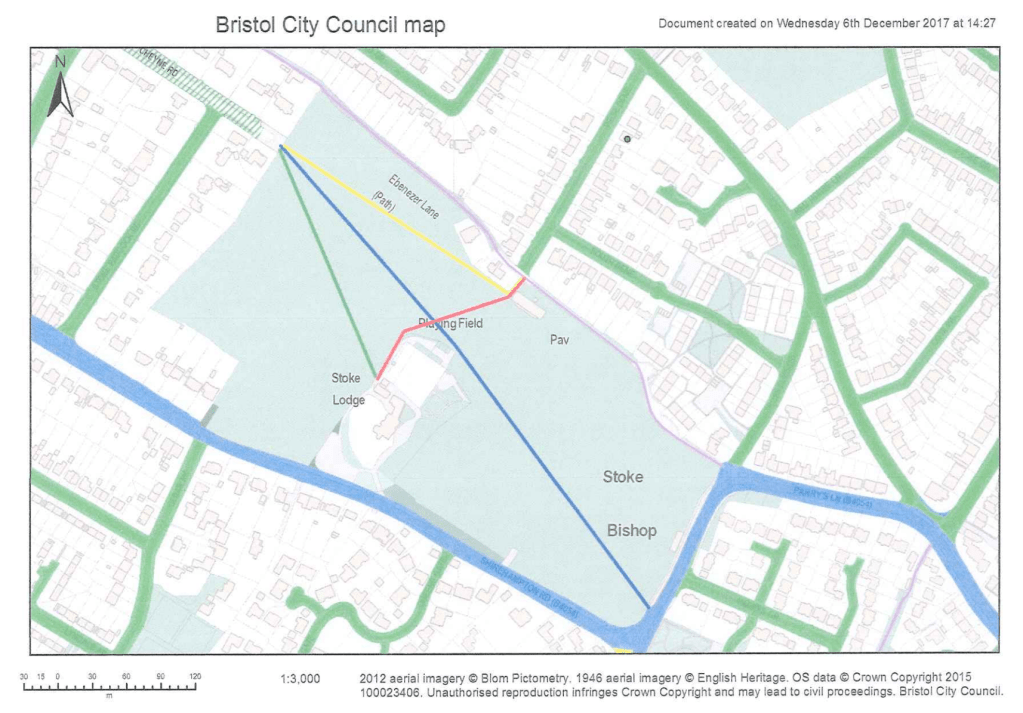
Here’s the application map for the claimed paths at Stoke Lodge:
You can see that the longest path runs from the Cheyne Road entrance right up to the gap near the mini-roundabout at the top of the field. TVG aficionados will remember that there has never been any sign at either end of this path. The others run in a rough triangle between the Cheyne Road entrance, West Dene and the Adult Learning Centre.
One of the discussion points at the PROWG Committee meeting on 28 June was that the wording on the old Avon signs at the West Dene entrance and at the Adult Learning Centre was ambiguous – it warned against trespass but also seemed to envisage that people would be on the land. One thing the signs didn’t do at all was to suggest that the simple act of walking across the field was off limits, and we know from Avon County Council’s own minutes and subsequent evidence that it didn’t intend to restrict either this type of use or wider informal recreation.
Why are these applications still necessary, once the TVG is in place? Because they protect a different type of use, and will protect rights of use for generations. Registering footpaths is increasingly important, in view of possible future restrictions on the ability to do this. Footpaths and greenways are a really valuable part of any neighbourhood, preserving the paths local people have walked over past generations and will continue to walk for many more. Once proved, they are marked on a ‘Definitive Map’ and protected by law.
Public footpaths often arise over time for a particular reason, and are hard to displace for that reason – for instance, in 2017 Harrow School lost a battle to divert two public footpaths running through its playing fields, even though it had built tennis courts and an astroturf pitch over one of them, as well as laying out other marked grass pitches over the second. The report of the planning inspector records that ‘the School operates in an environment of its facilities being used by members of the public and that there are many points of public access to the playing fields’ (sound at all familiar?). The planning inspector suggested that bins, not bans, would assist with any dog mess issues, and found that, despite the construction of the tennis courts and pitches over the public footpaths, the routes of those rights of way should not be diverted or obstructed. She noted that ‘any conflict is limited, both due to the fact that it is often the case that the pitches are not in use and, on the occasions when they are, all the evidence before me is that users divert around the pitch’.
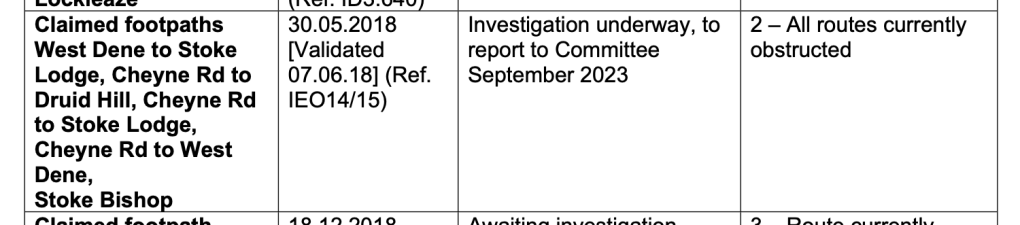
So, when do we expect the Stoke Lodge public right of way application to be heard? They are currently scheduled for September 2023, though in the nature of things the investigation might take longer than anticipated.
These paths have been much missed since they were obstructed – and the very limited opening of the Cheyne Road gate is a reminder of how badly access is needed at that end of the field. Of course, when the fence comes down the access issue will be resolved, but these applications are still necessary to put these historic footpaths (literally) on the map.
We’ve talked a number of times on this blog about landowner statements, and the fact that Cotham School asked BCC to make one in relation to Stoke Lodge in 2018. The significance of this is that in opposing our applications to register Stoke Lodge as a Town or Village Green, Cotham School spent a lot of time and legal fees on arguing that ‘everyone knew’ that there was a clear objection to use because of the public inquiry in 2016. But a landowner statement is a mechanism with one sole purpose – to end ‘as of right’ use – so if you think that use has already ended, there’s no need to even have a discussion about making a statement.
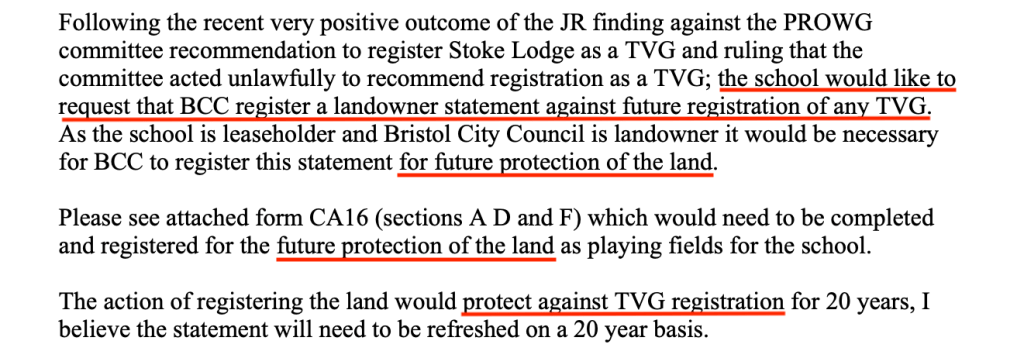
And now we have the email sent by Cotham School’s facilities manager in May 2018, asking BCC to make a landowner statement ‘to protect against future TVG registration’ (link on WhatDoTheyKnow here).
Notice his repeated theme: the land needs to be protected – against what? Against TVG registration. It’s absolutely apparent that the school thinks TVG registration is a real risk – which means the school did not think that the 2016 public inquiry had brought a clear and definitive end to ‘as of right’ use.
The same individual (no longer employed by Cotham School) made a statement to the PROWG meeting (describing himself as ‘independent of any interested party’) in which he asked ‘How can they now possibly claim they didn’t know their use was contentious?’. Well, now we know that in 2018 and on behalf of Cotham School, he recorded that the school itself did not think use had been made contentious by the previous public inquiry. If it did, it wouldn’t have rushed to request a landowner statement immediately after the High Court decision was handed down.
We also know (see earlier blog post here) that BCC got detailed legal advice about this issue, and on the basis of that advice it decided not to make a landowner statement. So either BCC thought that ‘as of right’ use was still ongoing and it didn’t want to take action to stop that, or it thought 20 years of ‘as of right’ use had already built up, and it didn’t want to provoke another TVG application (which happened anyway because of the school’s subsequent actions). In other words, BCC also didn’t think that the 2016 public inquiry effectively made use contentious.
But the point now is this – on 28 June BCC’s PROWG Committee voted (6 in favour, 1 against, 2 abstentions) to accept our applications for TVG registration. One of its specific reasons was that it did not think people generally knew anything about the public inquiry, so no objection to use had been communicated by it. Cotham School has said that it is considering its next steps – and it needs to consider those steps very carefully, since litigation is always a risky and expensive business. But with new evidence like this continuing to come to light and radically undermining the school’s own arguments, we think it would be very difficult to justify spending education funds on a further legal challenge, particularly in the current financial environment.
As we said immediately after the Committee’s decision, it’s time to move forward together. We stand ready to talk to Cotham about better ways of working together. It’s well-established now that TVG registration does not prevent Cotham School from continuing to use Stoke Lodge as its playing fields – there is no DfE or Ofsted requirement for a fence and TVG status protects the land as playing fields for everyone – school, clubs and informal users.
The past years have been challenging, but we hope that #SenseNotFence finally prevails, and that Cotham School will join us in seizing this opportunity for a fresh start together.
We are absolutely delighted to announce that the councillors on the Public Rights of Way and Greens Committee have voted, with cross-party support, to register Stoke Lodge as a Town or Village Green – 6 in favour, 1 against and 2 abstentions.
We are of course delighted with the outcome and will provide more information when we have it.
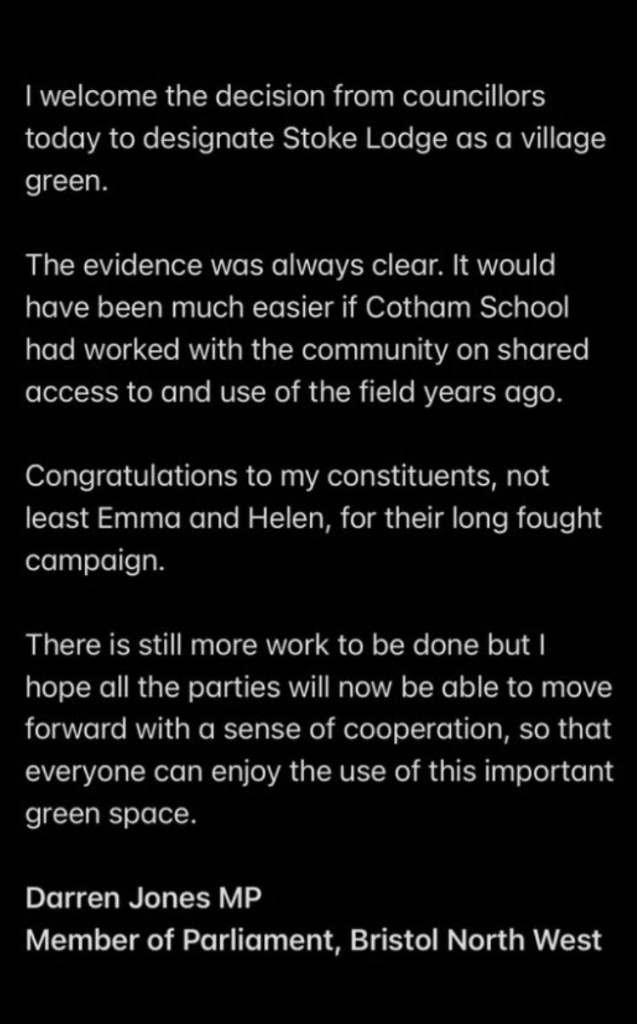
Here’s a message from Darren Jones, our MP:
We echo that sentiment – it’s time to move forward together.
Thank you to everyone who has supported us on this journey – we know from the messages coming in following the meeting how much this means to each one of you. Stronger together? Definitely!
After years of argument, the one thing that the decision on the Stoke Lodge TVG applications is likely to come down to today is the signs – two signs put up by Avon County Council in the mid-1980s. Here’s why the Inspector’s conclusion on the signs is wrong:
First, he said in TVG1 that they were prohibitory and refused to revisit that conclusion despite the evidence having radically changed. The signs are clearly a warning about trespass, but they go on to envisage that people will be using the land for a range of activities. Previous cases have said that signs like this are ambiguous and ineffective. The Inspector refused to consider this because, he said, the High Court had upheld his interpretation of the signs. Then, in his final Note, he said:
But he didn’t go back to put that mistake right.
Secondly, he refused to consider whether all the evidence of inconsistent conduct by the Council and the School indicated acquiescence, because he said the signs overrode all that. But the Winterburn case is very clear that the landowner must ‘object and continue to object’. The Inspector agrees with us that Avon wasn’t objecting to use at any time after January 1990. So whether he’s wrong on Winterburn really matters, as he himself now admits.
And we’re not the only ones who think he’s wrong: the Open Spaces Society agrees with us that while signs can make clear to users that the landowner objects to their use, they will only be effective if they are ‘sufficient to make the position clear to those using the land. This will be a question of fact in each individual case.’ If everyone is continuing to use the land anyway and the landowner is perfectly happy with them doing so, then there is no clear objection.
The third thing that the Inspector refused to consider was whether two signs were enough, on a 23 acre field with multiple access points and residential gates, to make any objection clear. He said he saw no basis for considering that issue, even though it was the exact reason why the Committee disagreed with him in 2016, and the Council spent the next two years arguing before the High Court that there weren’t enough signs. Why did he blinker himself like that?
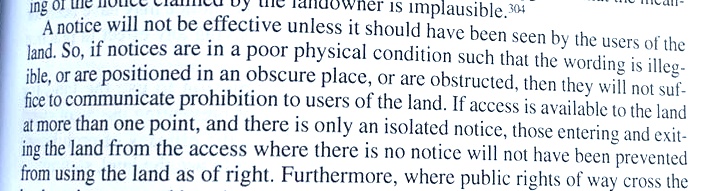
The leading legal textbook on TVG law makes the issue very clear:
That’s really important: ‘A notice will not be effective unless it should have been seen by the users of the land… If access is available to the land at more than one point, and there is only an isolated notice [Ed: or two!], those entering and exiting the land from the access where there is no notice will not have been prevented from using the land as of right.’
Nobody ever suggested to the householders with back gates onto the field that they couldn’t use them. So their use was ‘as of right’. There was never any sign at multiple other popular access points to the field – including Cheyne Road and the arboretum side of the main entrance. The signs were put in locations where school and club users were likely to see them, but not informal users. And a significant number didn’t see them – so their use was as of right.
That’s the key issue for today’s meeting. The only issue that matters.
The Public Rights of Way and Greens Committee is faced with very unusual circumstances on Wednesday. The Inspector wrote a report in March which contained obvious errors that were challenged by the applicants – for example, he said that the applicants weren’t contesting one issue at all, when there was a whole set of submissions and a 24 page annex on that issue. Clearly he hadn’t paid any/enough attention to the applicants’ submissions.
In the face of our representations, the Inspector wrote a final Note – and this is what’s so unusual. The Note admits that he made errors (though he doesn’t attempt to rectify them). It still fails to deal with the evidence he missed out and makes up a new reason for one conclusion which (inexplicably and inexcusably) is based on a poster that the Inspector hasn’t even seen. The Inspector’s Note also recognises that he might have misinterpreted the key case that he was relying on.
That case is Winterburn (the one about the tiny car park in Keighley). He now says that ‘It is necessary for the Committee to take a view about this. If I were wrong, then the Avon County Council signs would have been ineffective’ – which means that the land should have been registered as a result of the first TVG application. Years of controversy could have been avoided. That’s quite a mistake to consider – and he says it is necessary for the Committee to decide this for itself. He also says, in relation to our evidence that the Council and the School had acquiesced in informal use throughout the relevant period, that if that argument is correct then ‘it follows that, on the face of it, the land should have been registered’ on the earlier application. But he wrote his report from a starting assumption that the Council ‘cannot have been acquiescing’ in informal use – his predetermined bias (which flew in the face of the evidence) clearly influenced his recommendation.
The Inspector apologises for ‘misunderstanding’ the fact that we didn’t accept his assumption that ‘everyone knew’ about the public inquiry in 2016 and that ‘everyone thought’ use of the field was contentious after that. It’s very difficult to see how he could have ‘misunderstood’ this if he had actually read our submissions thoroughly. Even now he hasn’t attempted to review the evidence on this (which includes the Council defending registration in the High Court – much more widely reported than his public inquiry! – and the school putting up signs in July 2018 with the express intention of ending ‘as of right’ use. And the words ‘landowner statement‘ don’t appear anywhere in the Inspector’s writings, despite this being a huge piece of evidence confirming that both the Council and the school thought ‘as of right’ use was still going on – so why should the public think any differently?)
The Inspector has now changed the basis for his conclusion on this issue, and is relying on what he imagines one poster might have said in mid-2018, even though he hasn’t seen that poster. Yes, this would be farcical if it weren’t so serious. He now says this is a matter of judgment, and we are sure the Committee will be able to exercise better judgment than this!
The Inspector then says ‘The decision of course remains that of the Committee and if they are persuaded for whatever reason that I have got the law wrong, they will so decide and resolve accordingly… Ultimately I am either right or wrong and they have to take a view about that. As to the interpretation of the facts, there may… be scope for greater disagreement. It is open to a decision maker to disagree with an Inspector’s finding as to facts’ – so long as they give reasons for doing so (which is the only element that wasn’t fully achieved in 2016).
Finally, he says ‘It is not for me to suggest a way through the law and the facts whereby [the Committee] might conclude that the land is registrable as a town or village green and for such a conclusion not to be challengeable in law; it is for the Applicants to do this if they can.’
The main reason the Inspector gives for rejecting the applications is to do with the Avon County Council signs, based on his interpretation of the Winterburn case. But, in his final Note, the Inspector now admits that he may have misinterpreted the Winterburn case, by assuming that the signs were effective despite our evidence that the Council and the School acted inconsistently with them for 20 years. In fact, he says if he’s wrong on Winterburn then TVG1 should have been registered back in 2016 (so the last 7 years of stress, expense and fence need never have happened).
Let’s take a moment to think how extraordinary it is that, having written his report (supposedly having carefully considered all the evidence), the Inspector wrote a further Note saying he might have got the key issue wrong and it’s up to the Committee to decide, based on the facts. That is really remarkable, and means the report simply can’t be accepted as it stands.
We provided a mountain of evidence of the Council and the School acting inconsistently with the Avon signs, and this was not contested by the School or the Council. The Inspector’s position seems to be that if there is a sign then even 100 years of subsequent landowners being happy with informal use would not be sufficient to overcome the effect of that sign. Our expert barrister disagrees, as does the Open Spaces Society which said the following (obviously the OSS hasn’t been able to see the report because it was confidential until a couple of days ago):
The Winterburn case says that the landowner must ‘object and continue to object’ to the use. You can look this up for yourself here (see paragraph 37). It is completely clear that there was no continuing objection in our case. Even the Inspector accepted that from January 1990 Avon CC was not objecting to use of the field.
So the Committee will need to decide whether the Inspector is correct in his conclusion – in the context of the ongoing actions of the Council and the School accepting informal use, were the signs ‘sufficient to make the position clear to those using the land‘? ‘This will be a question of fact in each individual case.’
And actually, it’s even simpler than that. If the Committee considers that two signs are not enough to make an objection to use clear to everyone using the field, on a 23 acre site with over 30 formal and informal entrances, then the land must be registered as a TVG. That’s what the PROWG Committee thought in December 2016, it’s what Bristol City Council argued before the High Court in 2017, and the Inspector has now said this is a matter of fact for the Committee to decide. Take a look below and see what you think! Two signs may have been sufficient for the small car park in the Winterburn case (shown to scale, bottom left) but are two signs enough on a playing field that is 200 times larger? Has any objection been made clear when no one ever suggested to the householders with back gates onto the field, that they shouldn’t use them? Is any objection clear when the signs are left over from a previous landowner, in the mid-80s, and no one bothered to update the irrelevant wording on them?
We’d say clearly not – no one bothered to make an objection clear because no one was actually objecting! Remember that as far back as January 1990 Avon was talking about putting in a kissing gate at the Cheyne Road entrance – no indication of any objection there! The evidence speaks for itself – unfortunately the Inspector wasn’t listening.
The Inspector wrote a report back in March 2021, before he even asked for the evidence – he had mistakenly assumed he already knew all there was to know. In that report, the Inspector expressed the view that because he conducted a public inquiry in 2016 on the previous TVG application, ‘everyone must have thought’ that use had was no longer ‘as of right’ after that. Obviously we insisted that he should not have reached a view without seeing the evidence, but in his more recent March 2023 report (pages 13-44 on this link) he has remained wedded to that idea, saying that he did not think we were contesting it.
That was an extraordinary statement, since we had contested the idea throughout, and had attached a 24 page annex to our December submissions setting out all the evidence that proves him wrong on this. Those submissions are at pages 159 to 210 on the same link – the annex is at pages 180 to 203. Clearly he had not read our submissions thoroughly (or at all), and had not even looked at that annex. That’s just not good enough.
In his final Note (pages 222 to 226), the Inspector admits his error and apologises for that mistake but still does not deal with the evidence we put before him. Here are some of the facts the Inspector has ignored in order to maintain his position:
The Council had no power under the lease or the law to change the day to day use of the land by its conduct at the public inquiry.
BCC spent the next two years arguing FOR registration before the High Court. It said that ‘registration would reflect what has been the position on the land for at least the 20 year period prior to the application; it appears that the land has been used for a very long period for recreational purposes by the local community and the importance of the protection of recreational uses that arise from… registration should not be overlooked’. Why should anyone have thought that use was contentious, when BCC was arguing the opposite?
The Council itself did not consider that it had ended ‘as of right’ use – both it and Cotham School say in their submissions that the school put up new signs on 24 July 2018 with the specific intention of ending ‘as of right’ use i.e. they thought use was ongoing up to that date.
The School asked the Council to issue a ‘landowner statement’ to end ‘as of right’ use in summer 2018. This only makes sense if both parties considered that ‘as of right’ use was still ongoing. BCC has told the Information Commissioner that it took legal advice and decided not to make a statement – so either it did not object to ongoing use or it thought 20 years’ use had already accrued. Either way, both parties thought ‘as of right’ use was still going on. The Inspector doesn’t even mention this hugely significant issue. Why not?
Our evidence included, for example, Neighbourhood Partnership minutes from 2017 recording a decision to spend funds on installing a new dog waste bin – that would be patently absurd if local users thought that they weren’t allowed to use the field. But the Inspector has ignored all of this, as well as all the witness statements (which he never saw at all).
In his final Note, the Inspector admits that he made mistakes on this issue. He has changed position, and now suggests that a We Love Stoke Lodge sign displayed in mid-2018 may have indicated that tensions were heightened. But here’s the thing – that sign was not included anywhere in the evidence (because it wasn’t relevant to anything). It doesn’t mention anything about TVG applications or a public inquiry, so it doesn’t make the point he’s claiming. It actually talked about Cotham’s 2018 fence proposal, which BCC was also objecting to at the time! But even worse, the Inspector is drawing a conclusion based on what he imagines might have been on a poster that he hasn’t seen, while at the same time ignoring all the actual evidence submitted to him.
It’s not difficult to see that the Committee simply can’t accept the Inspector’s conclusion on this – they have to consider the issues and evidence for themselves, and these make it clear that he’s got it badly wrong. This is an example of why a public inquiry was needed – it shouldn’t have been possible for the process to end up with a mess like this.







 We need to talk about Stoke Lodge