
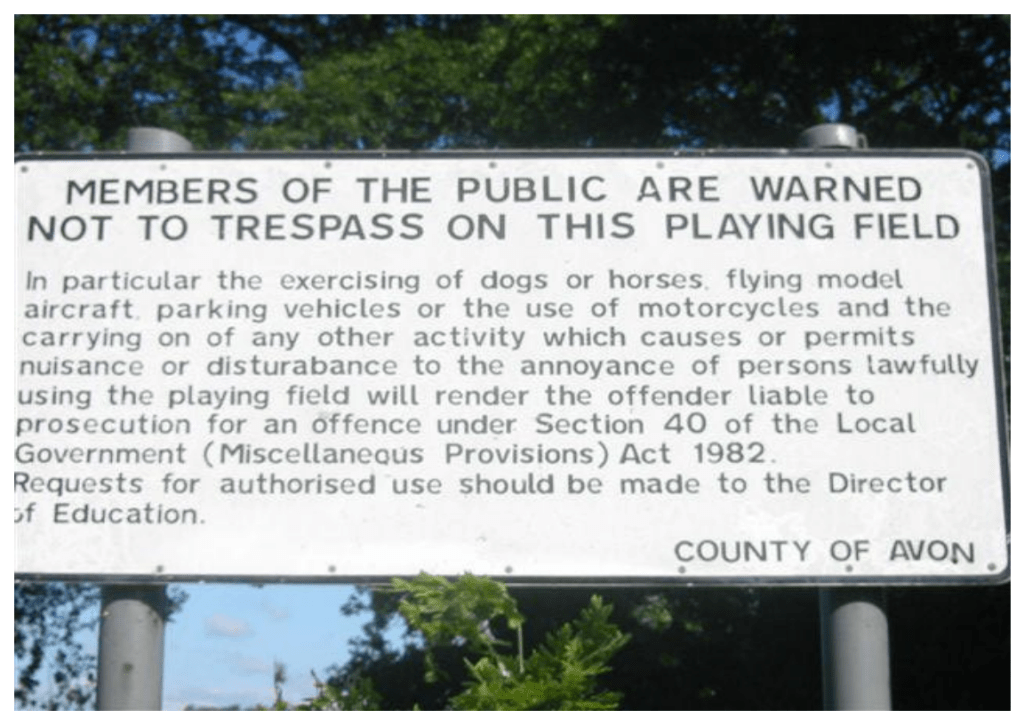
We’ve already talked about the signs that Avon County Council put up in the 1980s. This is what they looked like and yes, that spelling error was on the sign, so congratulations to whoever commissioned it and was not at all ‘disturabed’ by it.
So, why do we say these signs are not clearly worded enough to be effective?
Well, first of all do they prohibit trespass or not? They certainly warn against it – ‘members of the public are warned not to trespass on this playing field’. But the next chunk of text obviously assumes that people will be using the field, otherwise there would be no need to say that exercising a dog or a horse might in some circumstances be a criminal offence. There is a Supreme Court decision in which a sign that did the same sort of thing – ‘Warning. It is dangerous to trespass on the golf course’ – was held to be ambiguous. It was a warning, not a prohibition.
The main part of the text lists activities which, according to the sign, might be a nuisance under section 40 of the Local Government (Miscellaneous Provisions) Act 1982 and could be a criminal offence. In TVG1 the Inspector noted the ‘intrinsic ambiguity’ in this paragraph, because the Act doesn’t mention the five activities listed at all – it just created an offence of causing or permitting nuisance or disturbance to the annoyance of persons who were lawfully using educational premises. But the Inspector interpreted it as saying that trespass was forbidden and ‘in particular, the five activities identified… plus causing or permitting nuisance or disturbance are contentious’.
Cotham School’s barristers interpreted the sign a different way in TVG1, saying that some activities were prohibited but others (walking without dogs and informal recreation that didn’t cause a nuisance) were not. So that’s two possible meanings. But the Inspector concluded in 2016 that the County was taking action in respect of general trespass on education premises and so the signs were ‘confirming the pre-existing situation’. The problem with that, is that our evidence (which the Inspector didn’t have in 2016) shows that the ‘pre-existing situation’ was that Avon County Council ‘tacitly accepted’ public informal use of its playing fields – the Inspector was wrongly-informed about that by the Council’s witness in TVG1 (the Inspector himself described the recollection of that particular witness as ‘faulty’ and not ‘altogether reliable’). So this needs looking at again.
Avon’s minutes from the time also record concern about the under-use of its playing field facilities, and that notices should be erected to encourage use. That, of course, explains the wording at the bottom of the sign – requests for authorised use should be made to the [Avon County Council] Director of Education. In fact, the minutes in which the committee records its wish to encourage greater use of playing fields also indicate that these signs were intended only to deter nuisance activities, and don’t suggest that informal use was prohibited at all. That’s a third possible interpretation for the signs.
Finally, the relevant period for these applications starts in 1998, by which time Avon County Council did not exist. By that time, the criminal offence that the signs talked about did not apply to this type of playing field, and the Department for Education’s guidance was that notices warning of these provisions should now refer to the Education Act 1996. And due to other changes in the law, requests for pitch hire would now be made to the school that had the management of the field, not to the Director of Education, even if Avon still existed – which it didn’t.
So by 1998, what was left of the wording on these signs that was accurate and applicable? Only the phrase ‘members of the public are warned not to trespass’ – a warning, not a prohibition, just like the Supreme Court we mentioned earlier. All the rest was redundant or incorrect, and there are at least three possible ways of interpreting the signs even when the wording was valid.
Are these signs clear enough to be effective in prohibiting use – and was Avon even attempting to do that? Do the signs really express any clear intent at all?
 We need to talk about Stoke Lodge
3 responses to “The Avon signs – ambiguity”
[…] clear message prohibiting use (which apparently is not how anyone ever understood them – and click here for our post on ambiguity), and even if you think two signs is enough on a 26 acre field with many formal and informal […]
LikeLike
[…] signs were ambiguous (read more here) and were intended as a warning rather than a […]
LikeLike
[…] ways in which the signs that Avon County Council put up at Stoke Lodge were ambiguous and unclear (click to read more). That obviously affects whether or not the signs were effective, but there’s another […]
LikeLike