
The 20-year period for the current TVG applications runs from 1998, but we’re going to wind the clock back a bit further and, just for a minute, tell you some boring but important stuff about education law.
When Avon County Council put up its signs in the mid-80s, it was the local education authority and Stoke Lodge was being used by Fairfield Grammar School. From 1987, changes to the Education Act meant that control over the use of school premises was a matter for the school not the local authority, subject to any direction the local authority might make. Then from 1 April 1990 schools also got control of their budgets for things like maintenance and groundskeeping, again subject to any direction by a local authority.
Avon County Council did make a direction – it said that schools had to maintain facilities for adult education but subject to that, decisions about the use of premises were up to each school’s governing body. This direction, made on 23 January 1990, means that Avon had formally, using the mechanism provided to it in the Education Act, declared that it was not taking any position on the informal use of playing fields. It was up to the school using those fields to make decisions about informal use (and from 1996 schools were also required by law to have regard to the desirability of community use).
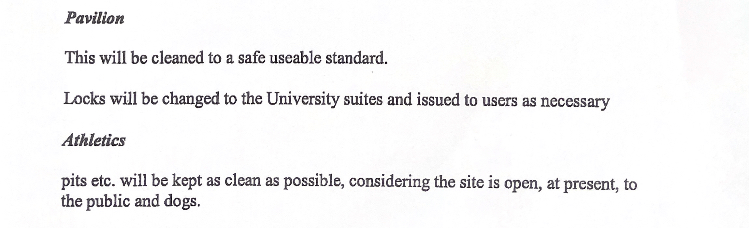
Sandra Fryer, the Chair of Governors of Cotham School, who has been a governor there since around 2001, gave evidence at the TVG1 public inquiry in 2016 that ‘use of the field was satisfactory from the School’s point of view’ in those years and that this ‘perhaps explained why signs had not been put up’. In other words, Cotham School did not object to informal use. That’s also reflected in the arrangements Cotham made with the University of Bristol to maintain the playing fields. Year by year these contracts recorded as part of the maintenance schedule that ‘the site is open, at present, to the public and dogs’.
There was extensive presence of groundskeepers, school staff and club hirers at Stoke Lodge on a daily basis, interacting with members of the public using the field. Multiple witnesses at the TVG1 public inquiry gave evidence of chatting with groundskeepers and of watching school and club matches. In 2016 the Inspector acknowledged that ‘this was not just a matter of local people going to the land only when the schools and clubs were not on it’. What the Inspector didn’t know then, because neither the Council nor Cotham School bothered to inform him, was that controlling the use of the land on a day to day basis was in the hands of the school, not the Council.
The conduct of the school provided visible messages on a daily basis that informal use was not a problem. Signs are one way of a landowner making a protest about use of the land clear, but inconsistent actions mean that the protest isn’t clear any more. Acknowledging that the site is open to the public and dogs; regularly seeing people using the land for sports or dogwalking and never asking them to leave; not putting up signs because ‘use of the field was satisfactory from the School’s point of view’ – these are all indicators of ‘as of right’ use.
 We need to talk about Stoke Lodge
2 responses to “Changes to education law and how TVG1 was misled”
[…] In the period from 1 September 2000 to 1 September 2011, Cotham School as the user of the land did nothing to make any protest clear. It repeatedly acknowledged over a period of years in formal legal contracts with the University of Bristol in relation to the management of the playing fields that ‘the site is open, at present, to the public and dogs’. […]
LikeLike
[…] gate was never actually installed, because right around this time education law changed (read more here) and Avon County Council formally resolved that it had no policy at all on the informal use of […]
LikeLike