
We’ve already talked about how Cotham School told parents and carers at the school, and officers at the Council, that it must have a fence at Stoke Lodge because ‘Ofsted requires a fence for safeguarding’ (click here) – and how Ofsted has made very clear that this isn’t true.
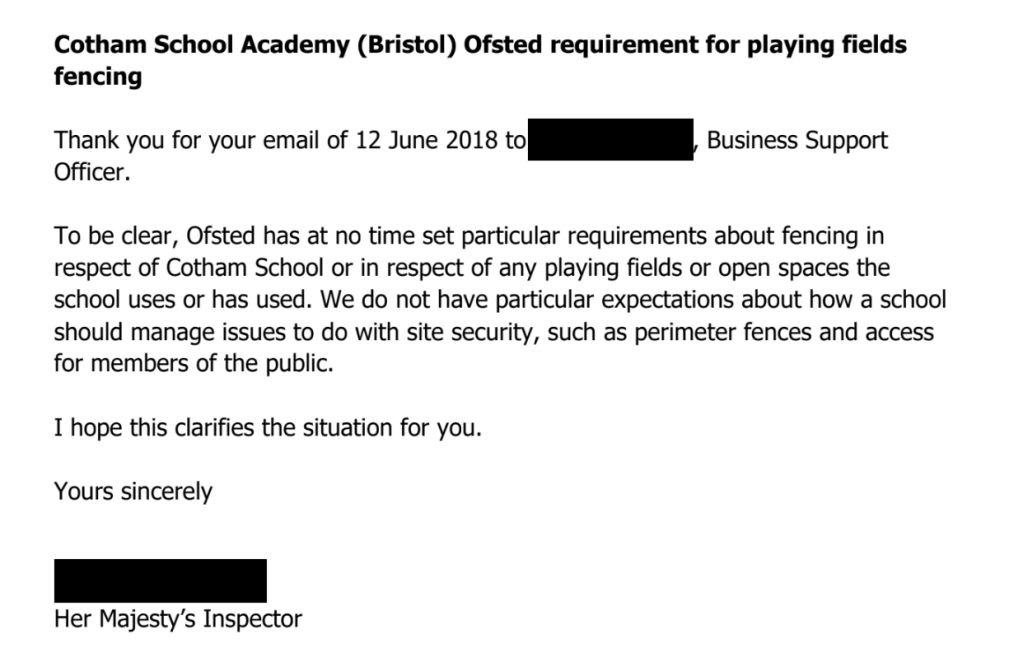
This week, we want to lay out the facts so that parents of Cotham School pupils can see for themselves that Village Green status for Stoke Lodge does not mean that Cotham will be deprived of its playing fields, despite the spin they may have been given on this in the past.
The school says it has a risk assessment that shows a fence is required, so let’s look more closely at that – and first of all, let’s pause to consider that Cotham School never carried out any risk assessment at Stoke Lodge (or at Coombe Dingle Sports Complex where it held most of its PE lessons) until 2014 despite having used the field since September 2000. But in early 2014, the school asked external consultants to carry out a feasibility study about building more classrooms at the school and about options for ‘upgrading’ Stoke Lodge. You can see that feasibility study here.
The report says several interesting things, including:
‘In terms of the Stoke Lodge Playing Field proposals… the study will need to result in a scheme to submit to get planning approval, noting that an application for “Village Green” status is currently under consideration by Bristol City Council and the expectation is that this status will be awarded.’
The options in Appendix G of the report set out two ways in which the field might be shared half and half with the community – perhaps envisaged as a negotiating stance. Most significantly, in terms of where the school might get grant funding from, the report notes that grants from the Academies Capital Maintenance Fund would be judged by various criteria and that, in terms of outputs to be achieved, ‘Areas of investment are likely to be prioritised towards Safeguarding projects and Improvements to play and sport spaces.’
This report was received by Cotham’s governors on 24 March 2014. Sandra Fryer had also asked the facilities manager at the time, Nathan Allen, and another staff member to go and carry out a risk assessment, which they did that same day – you can see this here. In the knowledge that 50% of the ‘score’ for a funding grant depended on showing that there was a safeguarding need or an improvement to sport spaces, the risk assessment purported to discover… a safeguarding need at a sports space. What a coincidence!
The risks identified were: (a) dog mess on the playing area ‘due in part to a lack of sufficient dog waste bins’; (b) dog attack, stating that ‘interaction between dogs and students playing sport happens on a regular basis’ and (c) ‘Violence & Aggression from trespassers gaining access to the playing fields’. Of these, the risk of dog attack was rated ‘high’ meaning that use of the playing fields should cease until the risk was mitigated – although in fact governing body minutes show that the school had ceased using the fields four months previously, preferring to use the facilities at Coombe Dingle.
On being asked about the incidence of dog attacks at Stoke Lodge, the school has confirmed that there have not been any – nor any incidents of violence and aggression from trespassers. But the risk assessment bolstered the school’s position for funding applications as well as giving it leverage in pushing for a fence.
What did other experts make of the risk assessment? One professional has commented that it was foolish to fence off such a large area – there is no point from which the whole area can be monitored, and indeed locals have frequently observed teenagers playing football on the pitches at the bottom end, while teachers are blissfully unaware of this at the top end of the field. Even on sports days, the school never uses the whole site at any one time.
The Council’s health and safety expert also reviewed the risk assessment, and said the following (click here):
- Other schools address the risk of dog mess by a visual sweep of the playing fields prior to use.
- As for dog attacks – ‘do we have any evidence of attack’? ‘Interaction does not mean attack. My general understanding of dogs and balls is their desire to join in the play/activity as opposed to attacking staff/students. Plus I would suggest that there are already ‘Existing Controls’ being the staff on duty, supervising the students. They can politely request that dog owners remove their dogs… The majority of law-abiding citizens of Bristol would respond to such a sensible request.’
- ‘I have no knowledge of any acts of Violence and very few ‘exchanged words or aggression’ towards staff on any playing fields across Bristol’.
So there you have it – this overcooked risk assessment was produced ‘to order’ as a way of bolstering the school’s case for grant funding. It overstated the risks, and it completely left out the obvious fact that pupils are not left out there unsupervised.
The risk assessment was then used as an all-purpose tool to push through the school’s desire for a fence. In fact Cotham’s headteacher, Jo Butler, used the risk assessment as part of her witness statement to the 2016 TVG public inquiry, stressing her certainty that Ofsted required Stoke Lodge to be fenced and (most shockingly of all) even referencing the shooting of 16 children and their teacher at Dunblane Primary School in 1996 in support of her claim.

But Ofsted says they’ve got it wrong. Cotham was proceeding on a false assumption, and that means it has spent huge amounts of time, effort and money in pursuit of a fence it wants, but doesn’t need.
 We need to talk about Stoke Lodge
5 responses to “Fact-checking Cotham’s risk assessment”
There’s so much said about what the school wants, but it doesn’t mean that they can have it. If it’s not allowed in the lease it can’t be done, they shouldn’t have signed it if they didn’t like it.
LikeLike
[…] was overstated and left out crucial features like the presence of teachers during lessons (click here). It’s worth noting that just a few weeks after that assessment, it was already being […]
LikeLike
[…] to be fenced for safeguarding purposes and that the risk assessment overstated the risks anyway (click here). We’ve shown that the Headteacher Jo Butler also accepts this (for example, in the […]
LikeLike
[…] the hard evidence tells a different story (and you can read more about that in previous blog posts here and here), it seems that over the years Cotham has locked itself into believing its own mythology […]
LikeLike
[…] Fact-checking Cotham’s risk assessment, on which it bases its claim that it needs a perimeter fence at Stoke Lodge […]
LikeLike