
As you know if you’ve been following our story, Bristol City Council has been prevented by the High Court from appearing in two different capacities in the litigation brought by Cotham School to challenge our TVG registration.
Cotham School had planned for the litigation to be structured as:
Cotham School (Claimant)
v
BCC (as Commons Registration Authority) – neutral
The community – defending registration
BCC (as landowner) – supporting registration
Now, there are a few things wrong with this. One, as clearly identified by the High Court, is that BCC is a single corporate body and cannot appear in two capacities in the same litigation (even on the same side and even if it was making the same arguments in both capacities – it is even less possible for it to become a claimant and sue itself).
Secondly, the Public Rights of Way and Greens Committee was outraged to discover that the CRA was planning to take a neutral position in the litigation rather than defending the Committee’s decision, and had taken that position without even asking them.
Both of those issues have now been corrected – BCC will be one defendant, represented by the Commons Registration Authority, and will actively defend the decision to register Stoke Lodge as a village green. So now, the case has a significantly different structure, with far greater costs risk for Cotham than it anticipated when it launched the claim:
Cotham School (Claimant)
v
BCC and the community,
defending registration
But the third thing that’s wrong is that officers acting for ‘BCC as landowner’ ever thought they could take action to challenge a decision made by a fully delegated regulatory committee. This triggered a furious reaction from Councillors on the PROWG Committee in January (you can read more about this in our previous post here). Since then we have continued to ask how this could have happened, since both local government regulations and the Council’s own constitution make clear that the Executive may not interfere with matters relating to village green decisions (just as the Executive may not lawfully interfere with planning decisions).
A response to an Audit Committee question has now revealed that the external costs incurred by BCC officers trying to challenge the PROWG Committee’s decision were £12,700 (plus £2,400 for the CRA which also argued for BCC to be allowed to split like an amoeba and act in two capacities) – plus, in real terms, the £1,800 BCC has had to pay towards our costs on this matter: £16,900 of taxpayers’ money, not including all the officer time spent. The public forum papers for this meeting are here.
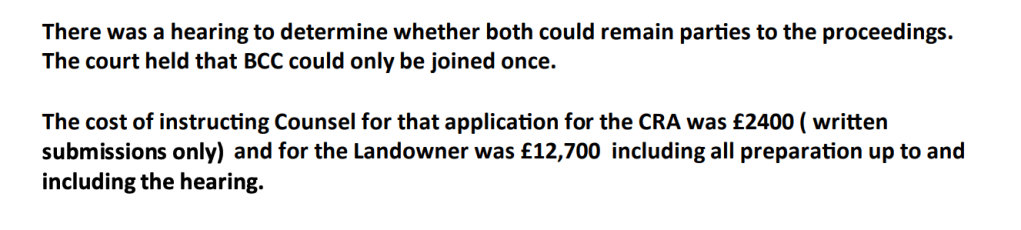
Questions were also asked at the Growth and Regeneration Scrutiny Commission meeting. The Public Forum papers for this meeting are here. In response to a question about whether Council resources – both in terms of money and officer time – have been directed appropriately in relation to Stoke Lodge, the following answer was given:

There are two points to underline here. First, the Council has not sought to take over the Cotham School claim – but ONLY because the Court put a stop to its plans. Its firm intention to apply to become a claimant alongside Cotham School, and to continue the claim if Cotham withdrew, was stated in writing and is not deniable.
Secondly, this is the first formal confirmation that in seeking to overturn the PROWG Committee’s village green decision, officers were acting on the instructions of the Executive. So the question is – which member or members of the Executive gave those instructions? This was discussed in some detail during the Public Forum part of the meeting, as you can see on this link.
The odd part of the verbal exchange is that there seems to be no recognition that the Council has a constitution and that officers were acting in breach of it – whether on the instructions of the Executive or not. The number of parties allowed in litigation is to do with court rules about civil procedure – that’s a separate point to the issue that once a decision is taken by a regulatory committee, that is the position of the Council – end of. Anything else is unlawful interference by the Executive. As Councillor Mark Weston said: “The Council tried to break the law – who signed off on the attempt to break the law?” The answer provided was: “I don’t have anything further to say on that.”
We intend to keep asking the question, not least because there is a wider concern – given that there has been so little regard for BCC’s own constitution in our case, there is a critical question – have the decisions of other regulatory committees also been affected by unlawful executive interference?


2 responses to ““Just following orders” – but who gave the orders?”
What’s the latest folks? Are you just waiting to hear?
LikeLike
We should know more in the next couple of weeks – we’ll keep you posted!
LikeLike