
“Many, if not most, of the open spaces – commons, woods, greens – that remain today in this country, exist because they were preserved from development by collective action.”1
There are estimated to be over 140,000 miles of footpaths, bridleways and byways in England and Wales – a network of paths, tracks and trails that have developed over decades and centuries as people moved through their shared landscape. But they have not gone unchallenged.
In the 18th and 19th centuries this network of connectivity was disrupted by waves of enclosure, as those with wealth and power took ownership of land that had previously been open to all.
- Richmond Park was annexed and enclosed by Charles I, seized back by the Commonwealth and then enclosed again by Charles II with only ‘permissive access’ allowed for years until finally in 1758 a local resident obtained a court declaration of public rights of way through the park.
- At One Tree Hill in Camberwell, there were plans in 1896 to build a golf course over the hill, and fences were erected to block paths used by locals. This led to a series of ‘agitations’ and ultimately to the compulsory acquisition of the site by Camberwell Council in 1905 to keep it open to all.
- Closer to home, the enclosure in 1859 of two pieces of land at the top of Pembroke Road, popularly considered part of the Downs, sparked widespread local outrage that was supported by the City of Bristol and ultimately led to negotiations by the Downs Encroachment Committee to secure Clifton and Durdham Downs and protect them by Act of Parliament in 1861.
So we stand in a long tradition – some of these famous open spaces whose existence we take for granted today are only there because people just like us stood up for public access, refused to accept enclosure, and fought (sometimes lengthy) legal battles to defend that principle.
In some cases local councils – even a past version of our own City Council – supported their citizens for the benefit of the public good. In others, the local residents did it alone. Still today we see those seeking to privatise public land for their own purposes using their access to resources, together with heavy-handed threats, to intimidate people into submission. And today as in the past, whether on a local or national scale, local people stand up to protect the land they love.
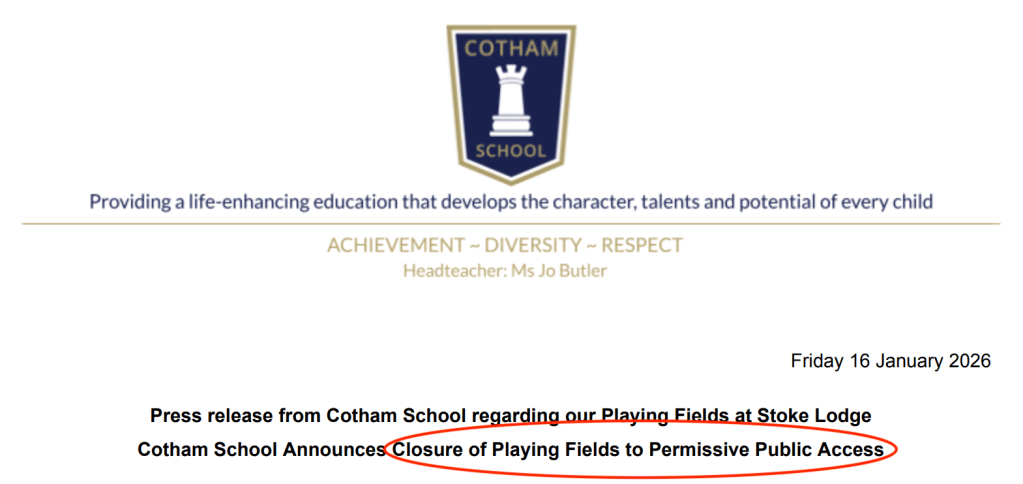
We are part of an honourable tradition that is strongly protected in UK law – that where locals have used footpaths ‘as of right’ for over 20 years, those routes are legally protected as a public right of way. That is a RIGHT, a legal right, to pass and repass over what used to be known as the ‘King’s highway’. Our use of those paths is not ‘permissive’ – it’s not something that Cotham School can dictate terms about. And in any case, their lease makes their rights ‘SUBJECT TO all existing rights and use of the property, including use by the community’. So when Cotham School talks about closing Stoke Lodge to ‘permissive public access’, that’s just gaslighting:
People have been protesting privatisation of open space since the 17th century:
“The law condemns the man or woman
Who steals the goose from off the common,
But lets the greater villain loose
Who steals the common from the goose.”
The public’s use of Stoke Lodge – and in particular of the rights of way – is not subject to the permission of Cotham School. The school’s leadership team is deliberately obstructing the footpaths as a power play, and trying to claim that use is permissive for the same reason (even though the High Court told them it wasn’t the case). They use enclosure by layer on layer of fencing and locked gates to try to break patterns of decades-long use and discourage the public from standing up for their rights. That won’t work.
They demand respect for their unlawful enclosure, but they don’t respect the community, the lease or the law.
- ‘Down with the fences: the battle for the commons in South London’, Past Tense Publications 2004 https://www.alphabetthreat.co.uk/pasttense/downwiththefences.html ↩︎

