
Long-time Lodge-watchers may remember that back in 2018, Bristol City Council confirmed that the land surrounding Stoke Lodge house was the curtilage of the listed building (curtilage status gives it special protections in planning terms). Then Cotham’s planning consultant Mike Orr (now of Rapleys) wrote to BCC asking for that to be changed, because having to make a planning application to put up a fence would be ‘devastating’. His letter argued against curtilage status (read more here). Among other things, he said of Stoke Lodge and the land surrounding it that ‘Historically, there appears to have been more than one ownership’.

That was always an odd thing to say – yes, the whole estate has changed hands half a dozen times over the years, but the house and land have always been owned together, since before 1861.
When Cotham made its CCTV application in 2025, its heritage consultant took this several steps further, saying
‘Historically the majority of the land that makes up the Playing Field was in separate ownership to Stoke Lodge, and no significant historical association between the two entities has been identified.’
Both the Council and the Planning Inspector robustly rejected that claim, with the Decision Notice stating:
‘The Council’s case in this regard is compelling and identifies the value of the playing fields as historic parkland… While this is heavily at odds with the applicant’s conclusions… it references historic mapping showing single land ownership and the site’s historic associations with not only Stoke Lodge but also its significance in the social and economic development of this part of Bristol.’
So how can it be that Cotham’s heritage consultant still claims that the land has no historical connection with Stoke Lodge, when all the evidence says it was a designed parkland setting for the listed building? It turns out that once again, Cotham is having a problem with numbers – this time, reading them.
Here is the image from the 1841 tithe map that was included in Cotham’s heritage statement. You can see that it’s a poor quality image so the consultant has helpfully – or not – overwritten the numbers that indicate each tithe area:
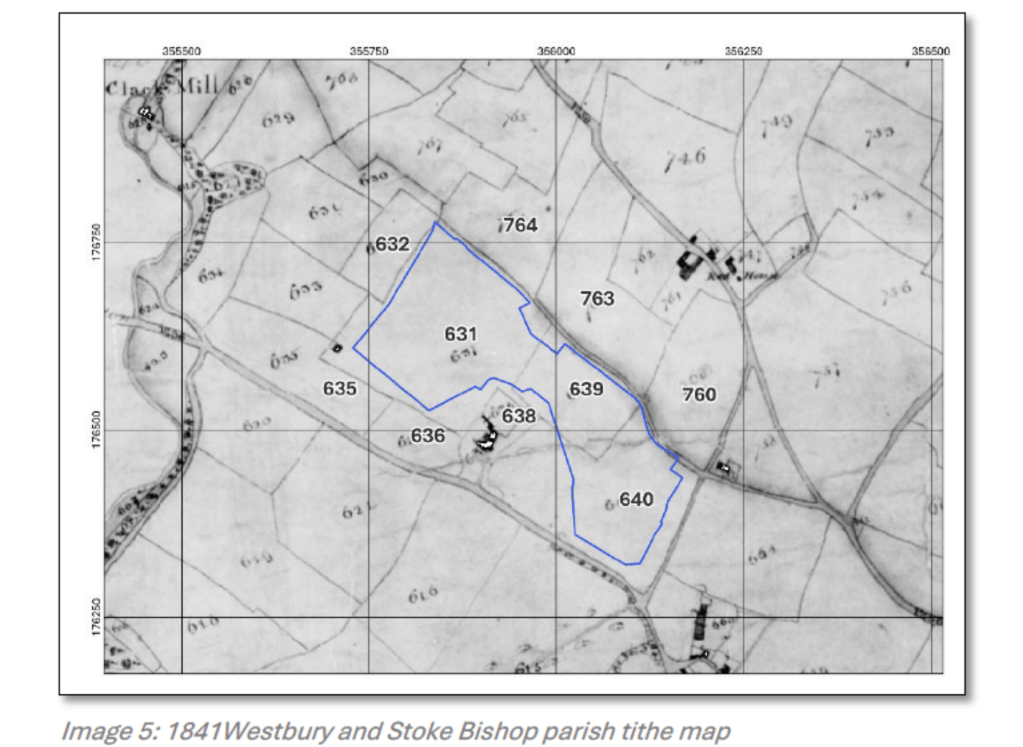
Despite being told that he was completely wrong about historic ownership of the land, the consultant included the same image in his report for the second (current) CCTV application. And the problem comes when you look at the actual tithe map, without those ‘helpful’ modern numerals:
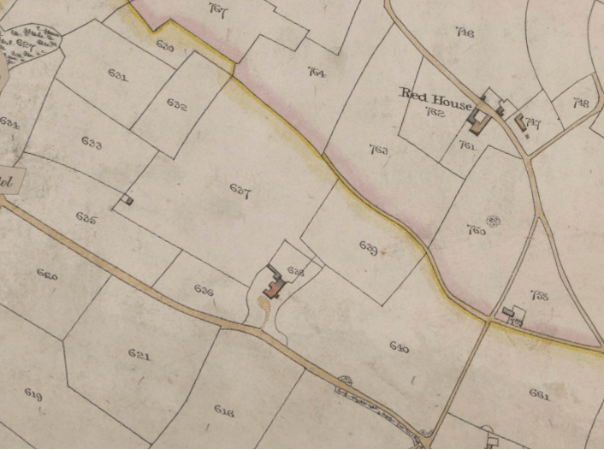
The number that Armour Heritage has overwritten as 631 is in fact 637. Field 631 is further northwest. And when you look at the list of apportionments (you can find this on KnowYourPlace), you find that tithe area 637, like 636, 638 and 640, all belonged to the owner of Stoke Lodge at the time, Thomas Bowman.

We also know that field 639 was added to the estate a few years later and the Lodge cottages were built and a drive laid from the house to Ebenezer Lane. The process of bringing together the Stoke Lodge estate did not happen overnight, but the parkland as we now know it was complete by 1860, with a stone boundary wall defining its borders and specimen trees planted within.
Of course, it might be just an oversight that Cotham’s heritage consultant lists the ownership names for each area from 636 to 640 but just happens to omit 637. It may be an unlucky misreading of the number on the map, coupled with an unfortunate coincidence that he didn’t spot 637 in between 636 and 638 on the apportionment list. Maybe.
But to make that double fault once, to be told very firmly you’ve got it wrong, and then to double down on the double fault as part of a controversial planning application, in a bid to say that this Council-owned historic parkland has no heritage value at all… well, it’s just lucky that it’s come to light so that officers aren’t misled.
Because protecting heritage matters – as BCC reported to PINS:
‘Stoke Lodge has particular significance in being well-preserved, retaining its park at its maximum extent, and with its character largely intact. All of the other houses mentioned north of the Downs have since succumbed to increasing subdivision and sale of their parks for more dense development, but Stoke Lodge remains almost complete, and is therefore a rare survival.’
We agree. We’ve had enough of efforts to degrade and downgrade this publicly-owned asset, part of Bristol’s heritage.
It’s not ‘just a playing field’. Never has been, never will be.


One response to “The tithe map trick”
Excellent work, folks.
LikeLike