We already know that TVG registration, and the fence coming down, won’t prevent Cotham School using Stoke Lodge Playing Fields for its PE lessons. Shared use is the basis on which it took the lease, and it’s a relatively common model for school playing fields. But that doesn’t mean that Cotham would have no control at all over any actual risks to its pupils during lessons.
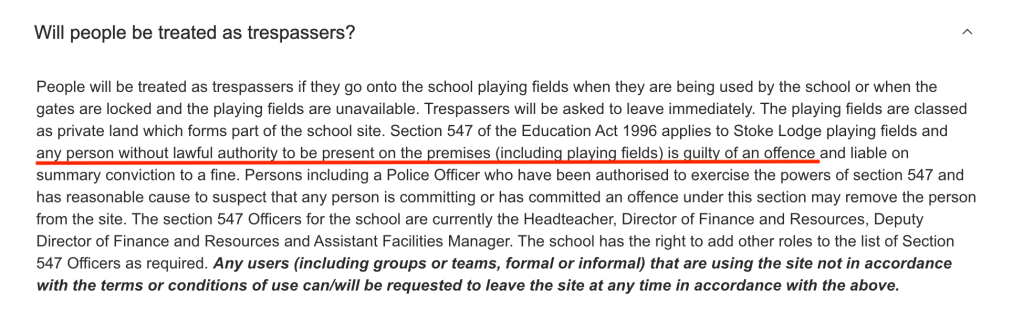
The law provides a way for schools to control nuisance and disturbance on their premises, including playing fields. Cotham School has recently published the following statement about this:
The problem is, this statement isn’t true. It’s not correct that ‘any person without lawful authority to be present on the premises (including playing fields) is guilty of an offence’. Here’s what section 547 actually says:
You can see that it’s not ‘being present’ that is an offence, but being present and causing or permitting nuisance or disturbance to the annoyance of lawful users. And ‘nuisance or disturbance’ isn’t just ‘stuff that Cotham doesn’t happen to like’ – it has a legal meaning. The DfE’s guidance on this when the Act was published was:
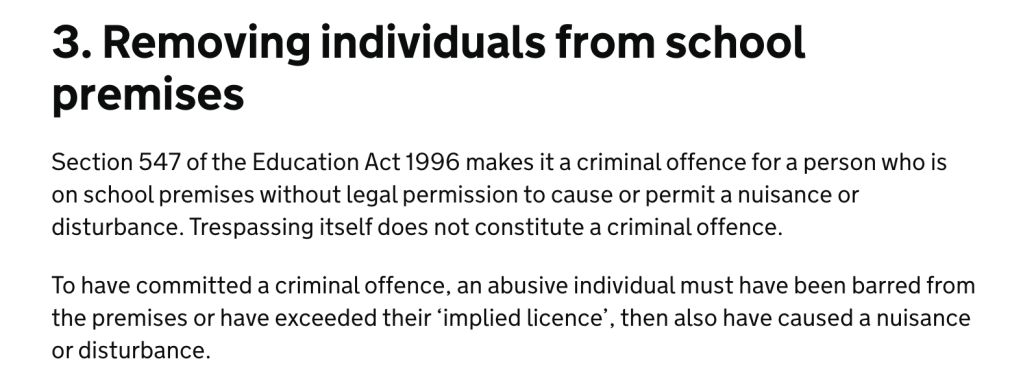
So – other activities might also be a nuisance, but the bar is a lot higher than Cotham is trying to claim. And suggesting that just being there is a criminal offence is completely wrong, as the school must know. The DfE’s current guidance is here and it makes this clear:
The same guidance says that schools can bar someone from school premises if they feel that the individual’s ‘aggressive, abusive or insulting behaviour or language is a risk to staff or pupils’. That’s not just going for a walk on the field. Then there’s a process to be followed, including giving the individual notice and hearing their side of the story. And then, before you get to section 547, there must have been a ‘nuisance or disturbance’, in the sense recognised by the courts.
And remember, this land is not the school’s private and exclusive property (despite its claims to the contrary) – Cotham’s rights as tenant under the lease are subject to ongoing informal use by the community. We think it’s dishonest and reprehensible to suggest that people have committed a criminal offence just by being on the playing fields when that’s clearly not the case.
The government’s guidance on school security suggests that schools should ‘establish and maintain relationships locally and work in partnership with the police, local authority and others in the wider community’ to mitigate risks. Hostile and inaccurate statements intended to antagonise the community are not the best way forward.
We’ve spent some time going through the actions Cotham School took to get a fence put up to restrict public access to Stoke Lodge Playing Fields, and the arguments it used to get its way. Now we want to stop for a moment and say that not all schools are like that.
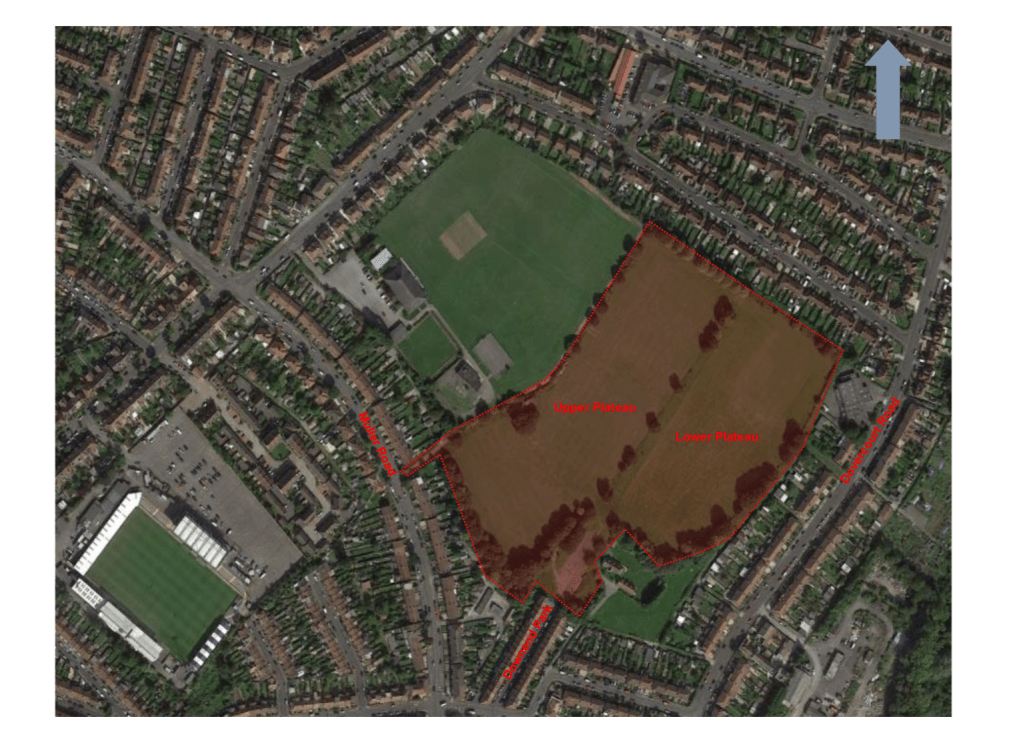
Our case study concerns Fairfield High School (which incidentally used to use Stoke Lodge for PE, from the mid-60s up to September 2000). Fairfield now has some sports facilities close to its site on Allfoxton Road, and also has long-term use of the grass pitches on Muller Road Recreation Ground as detached playing fields. This large open space is split into two levels, with pitches on both the upper and lower levels. Under Bristol byelaws, members of the public can walk their dogs off-lead anywhere here, without restrictions.
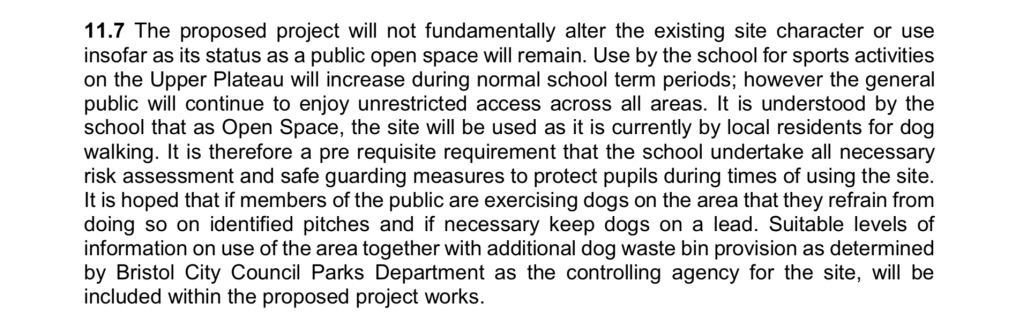
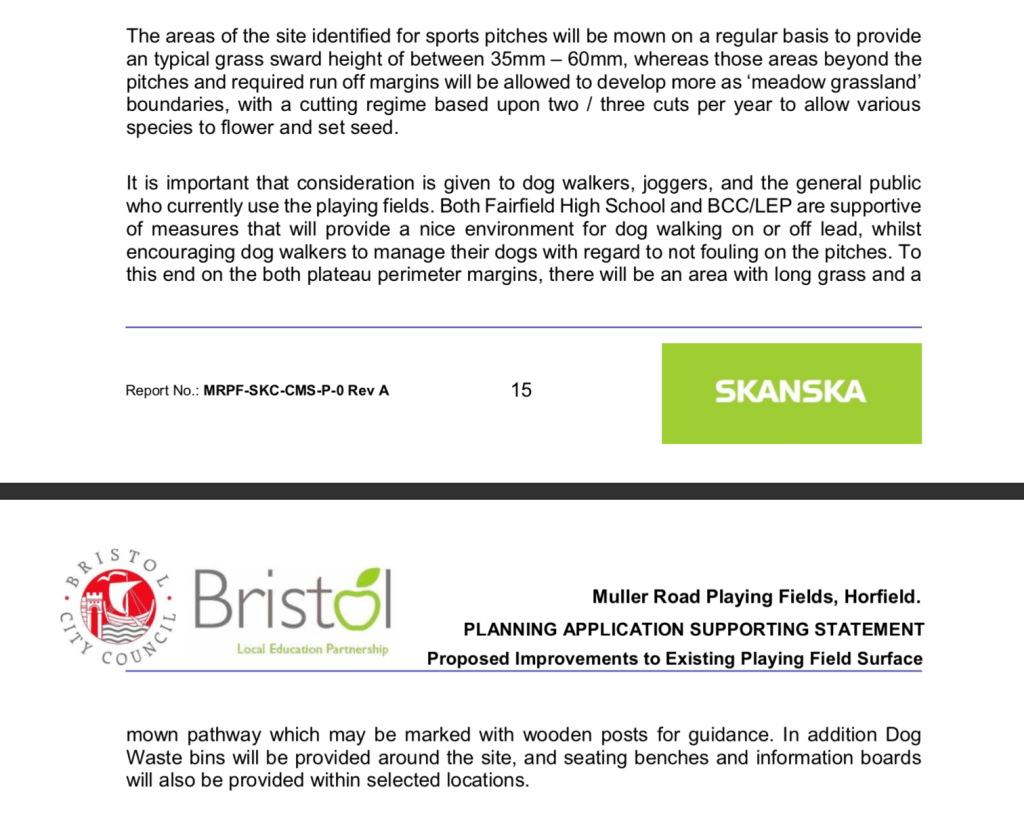
In 2016 there was a major refurbishment project for the pavilion and the pitches next to it on the upper level. But rather than using this as an excuse to fence off the pitches and exclude the community, Fairfield took a completely different approach. There was consultation with the community and an understanding by the school that ‘as Open Space, the site will be used as it is currently by local residents’, including for dog walking:
What’s better for the environment and far less antagonistic to the community than a fence? Different mowing regimes are used to differentiate pitches, pathways and spectator areas, because ‘it is important that consideration is given to dog walkers, joggers and the general public who currently use the playing fields’:
So you see, not all schools behave the way that Cotham School has done at Stoke Lodge. There is no ‘requirement’ that makes a school act that way.
How different might things have been if Cotham had done what Fairfield did? What if they had talked, rather than installing signs renaming the site ‘Cotham School Playing Field’ and then turning up with a riot van and body-worn cameras to install 1.6km of inappropriate fencing around this historic parkland with no consultation and, as they admitted themselves, no recognition at all of the community’s presence? What if they had considered the needs of local people with access needs or mobility issues, and provided appropriate access and pathways? What if they had agreed to use moveable pitch fencing rather than fencing the community out of the whole 23 acres? Things could have been very different.
In a world where you can be anything, #BeMoreFairfield.
We’ve spent the last few blog posts going through evidence that doesn’t strictly relate to the Town and Village Green application, but does shed light on what Stoke Lodge having TVG status would mean for Cotham and its students.
First of all, it’s really important to say that TVG status would not mean that Cotham would ‘lose’ its playing fields. There is an important principle in TVG case law known as ‘equivalence’ which means that the kinds of use that existed during the 20 year period on which TVG status is based, are protected in the same way on a TVG – that means school use, club use and informal recreation.
We’ve shown that Cotham signed up to shared use like this in its lease, and that community use was recognised in the lease in a number of ways that were (and are) financially advantageous to Cotham. The claim that ‘community use’ means hiring to sports clubs is simply untrue (click here). As the Council has said, given that Cotham took the lease after the TVG application had been made and that the ‘dual use’ was then being carried on, it was aware of the position and potential implications.
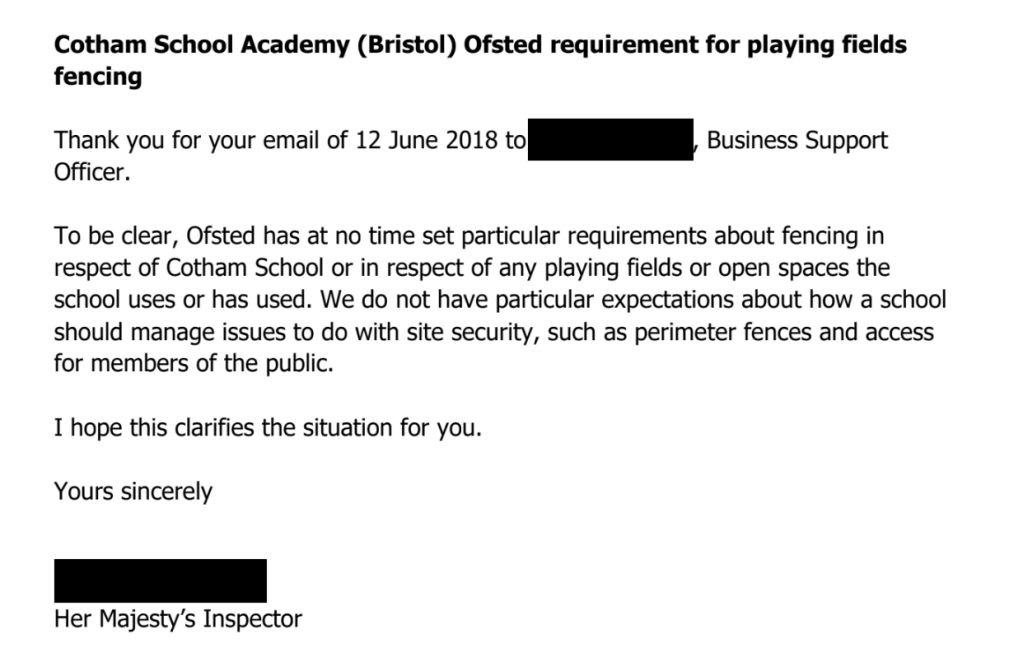
We’ve shown that Ofsted doesn’t require detached playing fields to be fenced for safeguarding purposes and that the risk assessment overstated the risks anyway (click here). We’ve shown that the Headteacher Jo Butler also accepts this (for example, in the application to redevelop the pavilion that was made in early 2017, after the Public Rights of Way and Greens Committee had taken the decision to register the land as a TVG – click here). We know that the PE staff would prefer to provide more teaching time by using the facilities on the school’s own site as much as possible (click here). We know that other schools use detached playing fields with open public access for PE – it’s not an uncommon thing – but as Jo Butler said at the end of her witness statement (click here):
And that seems to be the issue (click here for a reminder of the 2014 plans). TVG status would restrict Cotham’s ability to develop and commercialise Stoke Lodge. But they have no right to insist on doing that, on designated important open space. And any such development wouldn’t be based on educational priorities – they can hire existing facilities closer to school and get more lesson time and lower travel costs.
We love seeing the students and clubs enjoying sport at Stoke Lodge. Don’t let anyone tell you otherwise. Our objection is to the fence and to future development – just as Cotham School always knew it would be. Sandra Fryer’s options paper said the current solution would be difficult to achieve because there was ‘no recognition of community presence’. The community deserves recognition, and recognition is written into Cotham’s lease. It can’t just grab the whole field because it happens to want it – what kind of example does that set for its students?
We didn’t want Cotham to spend vast amounts of money on lawyers instead of on great education, and over the last five years we have offered compromise solutions and talks to try to resolve the situation. But we are simply standing up for what’s right, and we’ll continue to do that, for however long it takes. We hope you will too.
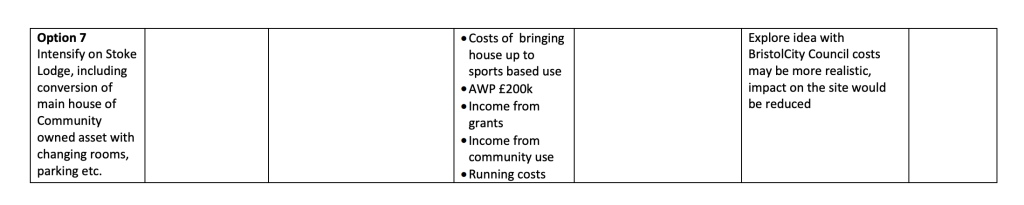
Following on from yesterday’s post, we’re still in 2014 and in the middle of the TVG1 process. Cotham School consistently claimed that it needed the whole of Stoke Lodge, didn’t know anything about any plans to turn it into a sports hub, and wanted to keep it as playing fields. Now let’s have a look at the options paper drawn up by Sandra Fryer with help from a planning consultant setting out ‘options for the long term use of Stoke Lodge’. You can see the options paper in full here.
Option 1 is to put up some extra signs (about keeping dogs off pitch areas) – the status quo is said not to be possible because of the risk assessment, but we now know that the risk assessment was overstated and left out crucial features like the presence of teachers during lessons (click here). It’s worth noting that just a few weeks after that assessment, it was already being suggested that signs and some minor fence repairs would enable the school to use Stoke Lodge – and then by November 2014 governors’ minutes record Ms Fryer suggesting ‘Need to revisit risk assessment and revise going back to using Stoke Lodge’ – the school didn’t really believe the risk assessment either, it was just a useful tool.
Option 2 is to move all sport to SL to save their hire costs at Coombe Dingle, but noting that year-round use of SL is not possible due to waterlogged pitches (still true).
Option 3 is to dispose of Stoke Lodge (something the school has always denied considering) and to develop a new all weather pitch on the school site (something they now have). It notes that ‘the University will be cross’ if they do this (as opposed to ‘University happy’ for option 1), although it’s not immediately obvious why the University’s opinion should be relevant to Cotham’s delivery of the PE curriculum.
Option 4 is to fence the site, restricting access to ‘minimal community use around edges of site’ – sound familiar? It also involves an all-weather pitch at Stoke Lodge which ‘could be an attractive asset for the school’. Note the comment that ‘this may be most difficult to resolve with the Community since no recognition of their presence let alone their dogs’. And yet this ‘most difficult’ option is the one that the school insisted on implementing in 2019 – and then it got annoyed that it didn’t go down well!
Option 5 is to split the fields into a ‘significant community park’ (perhaps the half and half solutions set out in the Bush Consultancy feasibility study?) plus more intensive sports use including an all-weather pitch.
Option 6 is a ‘sports hub’ proposal with an all-weather pitch and a ‘small local park’.
Extraordinarily, option 7 involved the school taking over control of Stoke Lodge house (the Adult Learning Centre) as well! For those who have been around long enough, this is essentially the Biddulph Plan (that the school has always denied it had anything to do with).
Each of options 4 to 7 involves putting an all-weather pitch on Stoke Lodge – which would mean more fencing around the pitch itself, and floodlighting (below is an extract from a document prepared by the PE staff showing that they won’t put floodlights around their onsite facilities because of local residents – but think it’s ok to do this at Stoke Lodge):
Now of course, this was 9 years ago. Some of these ideas have been actioned (there is now an all-weather pitch as well as a multi-use games area on the school site, although these are mostly left empty while lessons happen at Stoke Lodge). It’s fair to say that we don’t know what the equivalent plan now would look like. But it’s absolutely clear that Cotham will always be seeking to develop Stoke Lodge to the school’s commercial advantage (we know from the PE staff’s comments (click here) that it won’t be an educational advantage).
That’s why the TVG is vital to protect this important open space as we know it. Cotham is reluctant to admit that it doesn’t want the TVG because of the impact on its development ambitions, although the Headteacher let that slip in her witness statement to TVG1. That’s why Cotham ran with the ‘Ofsted requires a fence’ argument, but we know that this claim isn’t true. The school has been operating under a false flag; PE lessons at Stoke Lodge are not under threat from a TVG, but this important open space is certainly under threat of future development.
The year is 2014. The TVG1 application is in process, but what was happening behind the scenes at Cotham School? As 2014 opened, Cotham had already stopped using Stoke Lodge for sport and was investigating hiring pitches at Golden Hill instead of continuing with shared use of Stoke Lodge.
In May 2014 the PE department presented proposals to the school governors, seeking a new all-weather pitch on the school site because ‘Without time spent on travel, students would benefit from more playing time, there would be greater flexibility in the timetable and also ecological advantages…’
Extract from minutes of Learning and Wellbeing Committee, 1 May 2014
The Head of PE said that offsite provision of different types would still be needed to provide the full curriculum, and also during the exam period when the sports hall is out of use, and for matches etc.
To get a sense of how Cotham uses Stoke Lodge in the summer term (when it is most keen to take pupils off site due to exams taking place at the school), we looked at usage in the summer term of 2022. There are 10 possible 2-hour PE sessions per week, and over 10 weeks of that term, Cotham typically used Stoke Lodge for 6 to 8 sessions per week. Its lowest usage was 4 sessions in a week – obviously this is to some extent weather dependent, but the weather tends to be worse in other terms. How long are those sessions? On 2 occasions the actual teaching time provided was 1 hour (i.e. just 50% of the timetabled lesson). But that’s very much the exception: the average lesson was around 45-50 minutes and the shortest was just 35 minutes of the 2-hour period. The school has stated that travel time is about 35 minutes each way, so pupils inevitably spend longer in transit than actually doing PE. The PE staff are right to be concerned about this, of course – and Ofsted expressed a similar concern as long ago as 1999 (when Cotham was choosing to use Coombe Dingle Sports Complex, having abandoned its playing fields at Kellaway Avenue):
Ofsted inspection report, 1999
So the preference of the PE staff was clear, and was underlined again at a governors’ meeting in July 2014:
But the governors’ minutes suggest there was something of a power struggle going on – the Learning and Wellbeing Committee wanted to improve PE provision for Cotham students principally by doing PE on the main school site, while Sandra Fryer, then Chair of the Finance, Premises and General Purposes Committee, had drawn up an options paper showing alternative plans for the school’s use of Stoke Lodge. In tomorrow’s post we’ll look at that options paper and what it tells us about what Cotham really wants from Stoke Lodge – because clearly the school recognises that travelling from Cotham Lawn Road to Stoke Lodge for PE is not a good solution for pupils from an educational perspective.
We mentioned in the previous post the witness statement submitted to the TVG1 public inquiry by Cotham School’s Headteacher Jo Butler, in which she made various statements to support Cotham’s case for why Stoke Lodge shouldn’t be registered as a Village Green. In today’s fact-checking post we’re going to look at that in more detail.
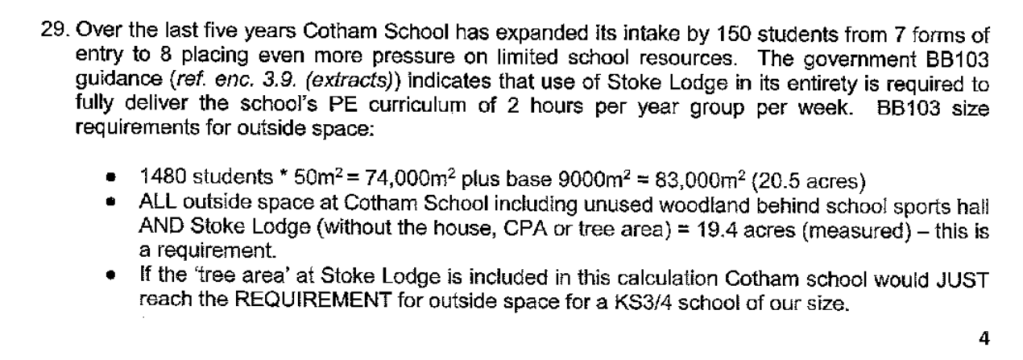
First, Ms Butler claimed that Ofsted required detached playing fields to be fenced, and we’ve already dealt with that – Ofsted has confirmed that’s not true. Next, she said that the school’s space requirements were such that they need the whole of Stoke Lodge – in fact she says they need the arboretum too even though it’s outside their lease (greedy!):
There are a few problems with these calculations. First, the ‘space requirement’ is a guideline, not a requirement as Ms Butler claimed. Secondly, the pupil admission number for Cotham School is 1215 at ages 11-16, not 1480. We assume Ms Butler is adding in the pupils in the Post-16 Centre there. And based on satellite mapping, both the school’s on-site space (including the multi-use games area and artificial pitch) and the size of the leased area at Stoke Lodge is greater than the school has estimated. When you tally all that up, the extra offsite space indicated by the guidelines is about half of the leased area at Stoke Lodge – which isn’t a surprise, because the school typically only uses the top end anyway.
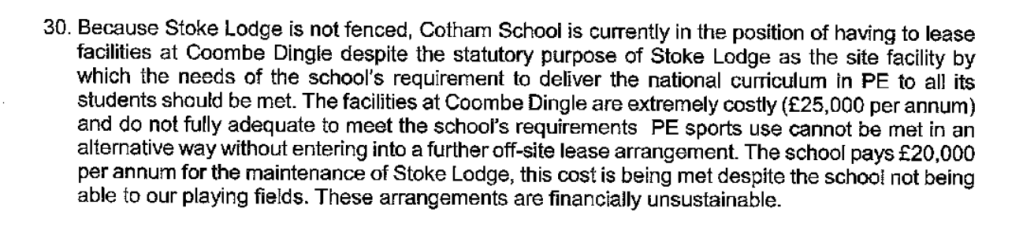
Next, Ms Butler says that ‘because Stoke Lodge is not fenced’, Cotham is having to pay £25k per year to hire facilities at Coombe Dingle Sports Complex.
This is clearly untrue, because we know that Cotham had been hiring facilities at CDSC since before 2000 (it stopped using its former playing fields on Kellaway Avenue in the late 1990s because it thought they weren’t of a high enough standard – those are now the playing fields of Redland Green School). And we have the data on hire costs paid by Cotham to CDSC from September 2011 onwards, and they increase year on year by inflation – there is no massive uptick in April 2014 after the school did its ‘risk assessment’. The truth is that Cotham already had its hiring arrangements in place before it abandoned use of Stoke Lodge, and carried them on in exactly the same way it always had done. What changed was that it didn’t want to pay to hire CDSC any more, which is fair enough but is not a reason why the public should lose the use of important open space. And by the way, CDSC didn’t have a perimeter fence all the way round at the time either, and there is public access to and through the site. So there’s that.
But towards the end of Ms Butler’s statement, we see a hint of something else coming through – the reason why Cotham really doesn’t want Stoke Lodge to be registered as a TVG. It’s not to do with public access (although the school is clearly very antagonistic towards the local community). No, it’s this:
If Stoke Lodge is registered as a Village Green, it will be difficult for Cotham to develop and commercialise it. Cotham doesn’t want grass pitches on important open space and rolling parkland, it wants artificial pitches (which would have yet more fencing and probably floodlights); it wants hardstanding for cars and coaches – it wants facilities to rent out, even though CDSC is better-equipped and only a couple of minutes’ walk away.
This is why the TVG is necessary – without it, this historic parkland estate will be lost under concrete and tarmac.
We’ve already talked about how Cotham School told parents and carers at the school, and officers at the Council, that it must have a fence at Stoke Lodge because ‘Ofsted requires a fence for safeguarding’ (click here) – and how Ofsted has made very clear that this isn’t true.
This week, we want to lay out the facts so that parents of Cotham School pupils can see for themselves that Village Green status for Stoke Lodge does not mean that Cotham will be deprived of its playing fields, despite the spin they may have been given on this in the past.
The school says it has a risk assessment that shows a fence is required, so let’s look more closely at that – and first of all, let’s pause to consider that Cotham School never carried out any risk assessment at Stoke Lodge (or at Coombe Dingle Sports Complex where it held most of its PE lessons) until 2014 despite having used the field since September 2000. But in early 2014, the school asked external consultants to carry out a feasibility study about building more classrooms at the school and about options for ‘upgrading’ Stoke Lodge. You can see that feasibility study here.
The report says several interesting things, including:
‘In terms of the Stoke Lodge Playing Field proposals… the study will need to result in a scheme to submit to get planning approval, noting that an application for “Village Green” status is currently under consideration by Bristol City Council and the expectation is that this status will be awarded.’
The options in Appendix G of the report set out two ways in which the field might be shared half and half with the community – perhaps envisaged as a negotiating stance. Most significantly, in terms of where the school might get grant funding from, the report notes that grants from the Academies Capital Maintenance Fund would be judged by various criteria and that, in terms of outputs to be achieved, ‘Areas of investment are likely to be prioritised towards Safeguarding projects and Improvements to play and sport spaces.’
This report was received by Cotham’s governors on 24 March 2014. Sandra Fryer had also asked the facilities manager at the time, Nathan Allen, and another staff member to go and carry out a risk assessment, which they did that same day – you can see this here. In the knowledge that 50% of the ‘score’ for a funding grant depended on showing that there was a safeguarding need or an improvement to sport spaces, the risk assessment purported to discover… a safeguarding need at a sports space. What a coincidence!
The risks identified were: (a) dog mess on the playing area ‘due in part to a lack of sufficient dog waste bins’; (b) dog attack, stating that ‘interaction between dogs and students playing sport happens on a regular basis’ and (c) ‘Violence & Aggression from trespassers gaining access to the playing fields’. Of these, the risk of dog attack was rated ‘high’ meaning that use of the playing fields should cease until the risk was mitigated – although in fact governing body minutes show that the school had ceased using the fields four months previously, preferring to use the facilities at Coombe Dingle.
On being asked about the incidence of dog attacks at Stoke Lodge, the school has confirmed that there have not been any – nor any incidents of violence and aggression from trespassers. But the risk assessment bolstered the school’s position for funding applications as well as giving it leverage in pushing for a fence.
What did other experts make of the risk assessment? One professional has commented that it was foolish to fence off such a large area – there is no point from which the whole area can be monitored, and indeed locals have frequently observed teenagers playing football on the pitches at the bottom end, while teachers are blissfully unaware of this at the top end of the field. Even on sports days, the school never uses the whole site at any one time.
The Council’s health and safety expert also reviewed the risk assessment, and said the following (click here):
Other schools address the risk of dog mess by a visual sweep of the playing fields prior to use.
As for dog attacks – ‘do we have any evidence of attack’? ‘Interaction does not mean attack. My general understanding of dogs and balls is their desire to join in the play/activity as opposed to attacking staff/students. Plus I would suggest that there are already ‘Existing Controls’ being the staff on duty, supervising the students. They can politely request that dog owners remove their dogs… The majority of law-abiding citizens of Bristol would respond to such a sensible request.’
‘I have no knowledge of any acts of Violence and very few ‘exchanged words or aggression’ towards staff on any playing fields across Bristol’.
So there you have it – this overcooked risk assessment was produced ‘to order’ as a way of bolstering the school’s case for grant funding. It overstated the risks, and it completely left out the obvious fact that pupils are not left out there unsupervised.
The risk assessment was then used as an all-purpose tool to push through the school’s desire for a fence. In fact Cotham’s headteacher, Jo Butler, used the risk assessment as part of her witness statement to the 2016 TVG public inquiry, stressing her certainty that Ofsted required Stoke Lodge to be fenced and (most shockingly of all) even referencing the shooting of 16 children and their teacher at Dunblane Primary School in 1996 in support of her claim.
But Ofsted says they’ve got it wrong. Cotham was proceeding on a false assumption, and that means it has spent huge amounts of time, effort and money in pursuit of a fence it wants, but doesn’t need.
Yes, it did say that. But this isn’t a school that’s notorious for its honest and accurate communication of the facts in relation to Stoke Lodge (see also “Those aren’t covert CCTV cameras, they are overt but discreetly located” – we’ll come on to the whole spy camera issue at a later date).
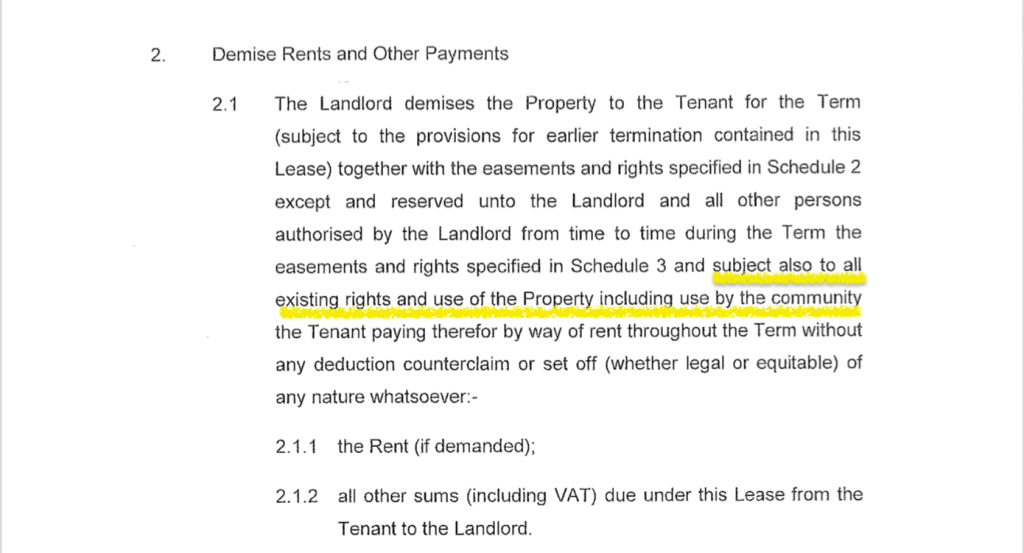
Here’s the clause in the lease:
In a video published in January 2019, Sandra Fryer (the Chair of Governors, who has been on the school’s governing body for over 20 years and was involved with the academy conversion process), said the following:
“The playing fields are now leased to Cotham School on a 125 year lease. To be clear, the reference to community use in our lease does not confer the right to use our playing fields but rather that the school can manage and enable community use when not required by the school.”*
But it’s very easy to see that this statement is simply untrue. Both the main school lease and the separate Stoke Lodge lease include provisions that allow Cotham to enable community use through sessional lettings, that’s true – hiring out the sports hall or a pitch at Stoke Lodge is absolutely something the school can do. Both leases have a very similar provision on this, but it isn’t clause 2.1 – it’s in clause 3.12 on ‘Dealings’. And when Cotham does hire out its sports hall or a football pitch, the hirer’s use will be subject to the terms imposed by the school (such as how much to pay and when to leave).
But the lease for the school’s main site has no equivalent of the community use wording that the Council specifically inserted into clause 2.1 of the Stoke Lodge lease. There is no suggestion in Cotham’s main lease that the school’s use of its buildings on Cotham Lawn Road is subject to ‘all existing use by the community’. And yet the Stoke Lodge lease says exactly that – the property is demised [leased] to the Tenant [Cotham] subject to certain rights that are reserved to the Landlord [BCC] and ‘subject also to all existing rights and use of the Property including use by the community’. This means something very different from hiring out a football pitch.
Even taking that simply as a point of grammar, is community use subject to the school’s terms and conditions in the way that a hirer’s use of the school hall would be? Clearly not! It’s the other way around: the school’s use of Stoke Lodge is subject to ongoing community use of the same character as the use that existed in 2011 when the lease was granted. That’s what the lease says, and that aligns completely with the 2010 Cabinet Briefing Note and BCC’s subsequent decision that shared use should continue (see our earlier posts here and here). Trying to say that the community’s use is subject to the school’s permission makes no sense at all when you look at the lease.
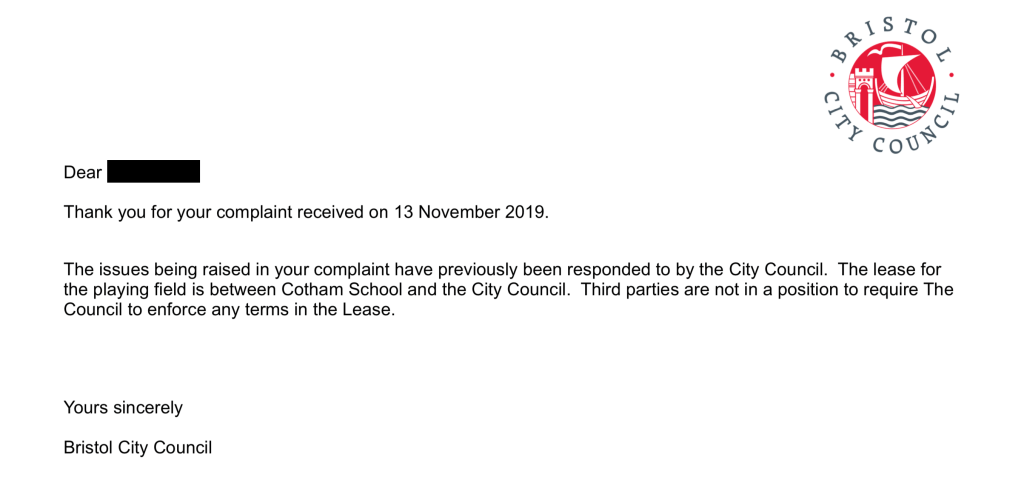
This means that even without the TVG in place, Cotham School’s use of Stoke Lodge under the lease will always be subject to community use, every day of every year until September 2136. Does that give the people of Bristol an independently enforceable right under the lease? No, because the lease is between the Council and Cotham School – we are reliant on our Council making sure that its tenant keeps its side of the bargain (remember that Cotham is getting a more financially favourable deal under the terms of its lease compared to leases for other schools, in return for ongoing community use). Can we trust the Council to do keep the school in line? Apparently not – here is the rather curt response received when the matter was raised in 2019:
Throughout this saga, the Council has had multiple opportunities to do the right thing and defend shared use, and has actively sought to avoid (or even eliminate) those opportunities and to deny any responsibility for the situation. Just like at Packer’s Field (see our earlier post here), warm words of assurance, or even the terms the Council itself negotiates in a legal document, won’t help to protect public use of our open spaces if the Council decides it’s not interested, or if it has a different agenda.
*You can find the full length video of Sandra Fryer’s statement here. Original video created and published by Justice4Cotham for Cotham School. Extract produced for the purposes of criticism, review and quotation only.
So what did the Council do after receiving the 2010 Cabinet Briefing note – the one that referred to ‘as of right’ use and to Stoke Lodge? The one that told the BCC Cabinet that Stoke Lodge Playing Field ‘is currently unfenced and allows unfettered community access’?
What happened next? Well, the Council didn’t put up any signs (nor did Cotham School until July 2018). It didn’t make a Direction (which was the only legal means for it to control use).
Instead, the Council held a consultation on the development proposals for Stoke Lodge Playing Fields in summer 2010 and these were roundly rejected. On 13 September 2010, the Cabinet Member for Education, Clare Campion-Smith, formally wrote to officers in the education team stating:
‘As you know, the cabinet requested last year that officers should explore the shared use of school playing fields and avoid fencing them off to the public unless there were very strong reasons for doing so… The consultation has taken place and all who responded were in favour of shared use. The cabinet has agreed that no fencing should be erected’.
On 15 September Clare Campion-Smith attended a meeting of the local Neighbourhood Partnership (which was the local area group with delegated authority through which the consultation had taken place) and confirmed her agreement to a resolution stating that ‘the Executive Member had given an assurance that the proposal to fence Stoke Lodge had categorically been dropped and that the parkland would remain with open access for all as of right.’
See those last three words? They aren’t there by accident, and because of the earlier Cabinet briefing and specific legal advice to the Council, their significance was clear.
Bristol City Council followed up in 2011 with an assurance in its public response to ‘Bristol’s Budget Conversation’. In answer to a comment referring to the Stoke Lodge proposals and saying that ‘I feel further fencing off of school playing fields is a waste of money’, the Council said:
‘We are happy to reassure people, once again, that we will not be fencing off the Stoke Lodge playing fields and quash this rumour once and for all’.
That ‘once and for all’ lasted until 2018 and a private meeting between Jo Butler (the Headteacher of Cotham School), Sandra Fryer (the Chair of Governors) and Mike Jackson, BCC’s freshly-in-post Head of Paid Service. This is the meeting at which the school complained about the very clear statement made by BCC officers in mid-July 2018 that the playing fields are the curtilage of a listed building (Stoke Lodge house) which meant that the school could not put up a fence without proper planning permission. On behalf of Cotham School, having to make a planning application was described as ‘pivotal and devastating’ – an odd statement given that the Chair of Governors is also a trustee of the Town and Country Planning Association, whose website states: ‘Planning matters to people. The way decisions are made influences people’s trust in local democracy and whether they feel at home in their communities.’ Quite.
The net result of that special pleading was a U-turn by the Council, which told Cotham on 21 September (a week after the TVG application was made) that it no longer considered the playing fields to be the curtilage of a listed building (quite a turn-around in just 2 months). The Council then, after giving Cotham that decision, got some hasty external legal advice ‘in order to confirm that we have a robust position in the event of the inevitable legal challenge brought by local residents’ – the words of Gary Collins, BCC’s Head of Development Management, in an email to Mike Jackson, Anna Keen and Asher Craig dated 24 September 2018.
Even at this point, Gary Collins’ position was that the type and height of fencing used would have to be acceptable to the Council in order for the school to obtain landlord’s consent. It was only later that the Council was persuaded to retreat further and hide behind the idea that ‘the fence is not a structure’ (that’s right, the 1.6km long, 2m high fence that is concreted into the ground and has security cameras, retractable bollards and auto-locking gates is not a structure according to the Council). Why did officers make that move? Because the fence had to not be a structure in order for the Mayor to be able to say, as he did at Full Council in January 2019, that he had‘no power over this‘ – as landlord and local planning authority BCC took no responsibility at all for the situation created by their U-turn on curtilage. Notice, by the way, the Mayor’s repeated statement in that last video clip that “It’s gone through the Monitoring Officer” – we’ll come back to that in a later post.
As we’ve said before, this is how it’s done. Incrementally. Behind the scenes. Despite all assurances previously given to the public.
Before the signs went up in the mid-1980s, we know that Avon County Council had a policy of ‘tacitly accepting’ informal recreational use of its playing fields. Did the signs mean that the policy had changed? No, our evidence shows that wasn’t the case – both here and on playing fields elsewhere in the County, the Council continued to tacitly accept informal use.
Even if you think the signs communicated a clear message prohibiting use (which apparently is not how anyone ever understood them – and click here for our post on ambiguity), and even if you think two signs is enough on a 26 acre field with many formal and informal entrance points (click here for our post on sufficiency), you have to consider the impact of years and years of actions by the Council and Cotham School that were inconsistent with those signs. Those actions meant that the signs weren’t sending any clear message at all, which would mean that the signs weren’t effective to stop informal use being ‘as of right’. Here are some examples:
In 1987 the gate at the West Dene entrance was locked by a new groundskeeper. In response to public complaints the Council ordered it to be unlocked to allow continued access at that point.
In early January 1990 the Council went on record with a public statement, reported in the local press, that there were concerns about motorcycles accessing the field at the Cheyne Road entrance, so it was planning to install a kissing gate. That would have given unrestricted access to the entire field, from the main entrance at the lower end of the field (i.e. there was no concern about pedestrian access – although the gate was never actually installed). Click here to see the press cutting.
On 23 January 1990 Avon made a formal Direction that, subject to providing for ongoing adult education use, all other matters relating to the control of school premises were for the school governing body, not the council – so Avon clearly had no policy of objecting to informal use from this date (more than 8 years before the 20 year period for these applications began).
In the early 1990s a large branch fell off the veteran oak tree at the Cheyne Road entrance. The TVG1 public inquiry heard evidence that a groundskeeper had used a vehicle to push it so that it blocked the entrance – and was told by his boss to move it back into the field so that the public could still access the land (although it was left in a position that would make access for motorcycles difficult). It’s still there today.
The Council’s evidence in TVG1 included this statement: ‘Staff were certainly aware that the land was used by the public for informal recreation. Reasonable use was never challenged’. That’s the Council’s own evidence.
In the period from 1 September 2000 to 1 September 2011, Cotham School as the user of the land did nothing to make any protest clear. It repeatedly acknowledged over a period of years in formal legal contracts with the University of Bristol in relation to the management of the playing fields that ‘the site is open, at present, to the public and dogs’.
In April 2010, the Cabinet Briefing Note recorded that there was ‘unfettered public access’ to the playing fields (we’ll talk about this in more detail soon).
In September 2010, the Cabinet Member for Children and Young Peoples’ Services formally confirmed at a Neighbourhood Partnership meeting that the playing fields would remain unfenced with open access for all ‘as of right’ (again, more on this soon).
Throughout the whole period, there was day to day contact between groundskeepers, school staff, club hirers and members of the public – many witnesses in the TVG1 public inquiry gave evidence of this, as did many of the 166 witnesses who gave statements for the current applications. In other words what was ‘visible’ on the ground included ongoing daily informal use that was unchallenged by groundskeepers or school staff (in fact witnesses gave evidence of frequent friendly conversations and interactions).
In 2011, when the lease was being negotiated, Cotham School asked for an indemnity from the Council in relation to trees and boundary walls. Its solicitor stated that ‘excluding the playing field use, this land seems to me to be essentially open amenity land within a residential area’. The Council didn’t contradict him, and it agreed ‘a much reduced repair clause… which varies substantially from the Academy model’ in recognition of that open amenity use, as well as providing the indemnity. So the school got (and still gets) financial benefits in recognition of the shared use of the playing fields.
The lease was signed on 31 August 2011, recording formally that the school’s rights as tenant are ‘subject to all existing rights and use of the Property, including use by the community’.
On 5 October 2011, the TVG1 applicant wrote to Cotham’s head teacher and chair of governors, commenting on the lease between Bristol City Council as landlord, Cotham School as tenant and the community as ongoing users ‘as of right’. The letter refers to maintaining ‘clear dialogue regarding the ongoing use of the Parkland by both your Academy and the Community, in the harmonious way currently enjoyed by both interested parties’. The headteacher’s response says: ‘Thank you for your letter concerning Stoke Lodge and your express wish to maintain our close and harmonious relationship. We completely echo your sentiments…’. He didn’t quibble with the statement that there was ‘as of right’ use in a ‘harmonious way’ – it was accepted by both parties.
In the 2016 public inquiry, Cotham School’s Chair of Governors gave evidence that the School had been content with ongoing informal use of the Land in the period since 2000 and this was why the school had not put up any signs. That’s the school’s own evidence.
None of this evidence was contested by Cotham School or by the Council. How could they? It’s all documented. Well over 20 years of continuous informal use by the public for lawful sports and pastimes, without force, without secrecy and without permission. That’s ‘as of right’.











 We need to talk about Stoke Lodge