If you’ve been following the public inquiry into rights of way at Stoke Lodge Playing Fields, you’ll realise why we’ve been quiet for a while over here on the blog. But this is a multi-layered saga. Another major strand relates to Cotham School’s fixation on surrounding the historic parkland of Stoke Lodge with eight 6m high poles, with 360 degree CCTV domes mounted at the top of them. What follows will give you a flavour of the complexity created by Cotham’s multiple overlapping claims and applications.
Cotham made this CCTV application directly to the Planning Inspectorate (PINS) in November 2025. It was refused by PINS on 9 January 2026 for three key reasons: detriment to heritage assets, risk to protected trees, and loss of privacy for the residents around the field.
Undeterred, Cotham made another application, almost identical to the first except for moving one pole from by the house to the front corner of the pavilion and reducing it by 1m. That application was validated by BCC’s planning team on 2 April 2026 but remains ‘pending’. More of that anon.
Why would Cotham make a second application so nearly identical to one that was rejected? Well, it turns out that the school had applied for – and been awarded (subject to planning permission) – grant funding by the Department for Education towards the cost of the CCTV.

Now, you might find that a surprising funding priority for the DfE compared to fire safety and fixing the roof like the other schools shown in the snip above. Note that Cotham has billed the CCTV as being necessary ‘to deter vandalism’ – please see our previous blog post shedding light on the school’s exaggerated claims of vandalism in November 2025. On this link from the PINS application you can see Headteacher Jo Butler repeating the claim about “most horrendous vandalism” (remember – it wasn’t in fact 72 panels, but 2, and not “sawn down the centre with an electronic power tool and ripped open” – quite a vivid imagination at work there!). So although we haven’t seen the grant funding bid documents, we can perhaps make an educated guess about what kind of claims may have been made by Cotham to the DfE in support of their funding application.
In that same link, Ms Butler gave PINS some other reasons for needing CCTV (presumably these are the statutory safeguarding issues referred to for DfE purposes, and they don’t seem to be to do with the fence):
“- CCTV provides accountability when staff supervise students off-site
– Helps prevent bullying, fights, or inappropriate behaviour during school use
– Protects against allegations involving students or staff”
Of course, Cotham has multiple CCTV cameras already around the top half of the field – we don’t know if the DfE was made aware of that as part of the funding application.
Back to the planning application: this was refused by PINS, but funding is potentially available from the DfE and obviously Cotham School is keen not to let that go – so it has made a second, almost identical application that has received over 260 objections to date.
A third party FOI request has revealed that Cotham’s planning consultants (Rapleys) were putting considerable pressure on PINS behind the scenes in relation to the first planning application. PINS has a strict rule that applicants have to supply all information in one go, ready for public consultation. They can’t add to it later, but in this case Cotham and its consultants tried to do just that. Having seen the strength of the objections to their application (including the responses on trees and heritage issues from the Council) they tried to submit rebuttals. PINS told them no, Cotham School sent them in anyway and PINS refused to accept them. But in response to being told “No”, Rapleys sent this:
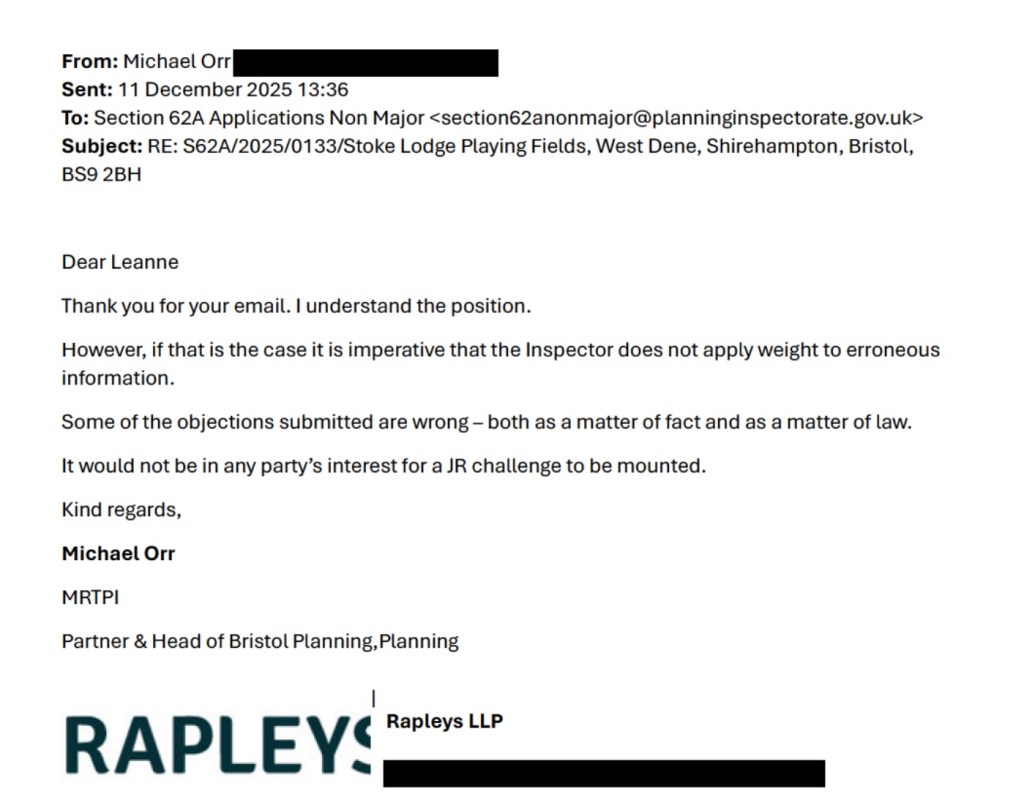
Setting aside the implicit threat in the final sentence (Cotham School seems to love spending school funds on litigation), it is pretty rich for Rapleys to suddenly be so concerned about erroneous information. And if you don’t already know why, we refer you to our previous blog post, ‘The Tithe Map Trick‘.
The rebuttal Cotham and Rapleys wanted to submit on heritage grounds included a statement that:
“The absence of any historic park boundary, such as a park pale, is a critical point that materially undermines the claim that the playing fields constitute a Non-Designated Heritage Asset of parkland character.”
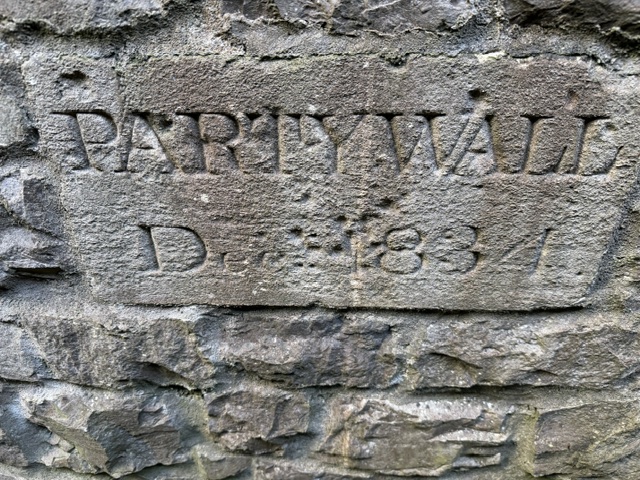
We invite Rapleys and Armour Heritage to pop over any time and have a look at the stone boundary wall around the Stoke Lodge estate that dates from the mid-1800s. Why, only a couple of weeks ago Cotham was claiming that the existence of boundary walls around the estate was a key argument against the public rights of way.
It’s funny how flexible Cotham’s ‘facts’ are – even when they’re made of stone.